
Updated March 28, 2026
Turn sound on video on/off here
The Grand Canyon is the busiest of our National Parks, last year drawing 4.5 million visitors. During my 3 visits to the park I learned a few in's and out's as far as visiting the Grand Canyon - especially when it comes to your travel budget!


March through May is the canyon’s golden hour—45-70°F on the rim, wildflowers splashing yellow and purple across red rock, and trails you can hike without risking heatstroke. Hotel rooms run $180-220/night, still 30% below the summer gouge.
June through August turns brutal: 80-90°F on the rim, 100-110°F inside the gorge. Every year hikers collapse—5,000 feet of elevation and they didn't bring enough water. Rates leap to $300-400/night and the shuttles feel like subway cars at rush hour.
September slides back to 75-85°F on the rim, crowds thin by 20%, and hotels settle at $200-250. October lights the North Rim's aspens gold—locals reappear, knowing the secret's loose but the masses clock back in.
November through February: South Rim 34-50°F, snow possible, North Rim locked up tight. Winter prices crash to $90-120/night; you'll watch sunrise from Hopi Point with five quiet souls instead of 500. Christmas week jerks rates to $250+ anyway. Insider play—book late October for North Rim aspen fireworks, then drive 4.5 hours south and hike the South Rim in 65-degree bliss. Both rims, one trip, both perfect.
Plan Your Visit in Advance!!!
Peak Seasons: The Grand Canyon is busiest from June to August. For lighter crowds and better lodging availability, consider visiting during the shoulder seasons of March-May or September-November.
Getting reservations for anything related to the Grand Canyon is now out several months to a full 1 year in advance!


During my 3 visits I've tent camped in Mather Campground, stayed in the Grand Railway Hotel, and during this latest trip, RV'd it.
If there's one thing I've learned, it's DO NOT STAY IN THE PARK ITSELF unless you have money to burn, love being among hordes of fellow tourists and waiting in line for just about everything.
At the Grand Canyon convenience comes with a pretty hefty price tag.
Tusayan is the closest town to the Grand Canyon Park. With in-park reservations being so difficult to get now, where do you think that 4.5 million tourist overflow heads when looking for their accommodations?
I've learned the place to stay is Williams, AZ for a couple of reasons. Sure, it's 60 miles and an hour's drive away from the Grand Canyon South Rim. But I'd much rather make that drive than be shoulder-to-shoulder with the tourist crowd. Furthermore, enough Grand Canyon activities are based out of Williams that it makes staying in Williams and making that hour drive justifiable. Not to mention more economical even with gasoline at nearly $4 per gallon now.
The Grand Railway Hotel
My late husband and I stayed at the Grand Railway Hotel on my second trip to the Grand Canyon and loved our stay there. When I crunched the numbers, the cost per night of a stay there was $353.95 plus tax. That's no worse than the price of any other decent hotel room these days. Yes, we took advantage of the hotel's special packages/discounts to get that price.
The AAA 3-diamond 298-room hotel is right next door to the train depot and just a block away from downtown Williams and historic Route 66. Fantastic location!
With a variety of amenities such as complimentary wi-fi, an indoor pool and hot tub, dining options at the Fred Harvey Restaurant and Spenser’s Pub, the Grand Canyon Railway Hotel is the perfect place to stay.


The room hubby and I had was clean, spacious and comfortable. We had no complaints about it whatsoever.
My advice would be check out this hotel, crunch some numbers and see if it would be a viable alternative for you and your family. Be sure to check out their packages and special offers when you do!
Money $aving Tip: This Spring & Summer Kids Ride & Stay FREE With This Exclusive 2-, 3-, or 4-Night Package
RV Parks
We had a choice between 2 RV parks for this latest trip. Grand Railway Hotel has its own RV park near the railway depot.
However, through Passport America we found an RV park in the town of Williams, an hour's drive from the Grand Canyon park - Raptor Ranch.
If you're a Passport America member, you paid only between $25.00 - $37.50 rates vs. the normal $50-$75 rates. And the South Rim of the Grand Canyon is only 24 miles away, about a 20 minute drive!
While the park sites weren't as secluded as we would have liked, the sites weren't cramped with RV's on top of one another.

Close to the Grand Canyon with 32 total RV sites, can accommodate RVs up to 60ft, pull thrus, back ins, 30/50 amp, full hookups, dump station, 25+ tent sites, FREE WiFi hotspots available in lounge and laundry room, restrooms, showers, laundry, BBQ, Grocery Store on Site Restaurant on site, campfire rings, firewood available at the Camp Store, Gift Shop, snacks, coffee, propane, playground, volleyball, FREE Raptor Flight Demonstrations to ALL Campers, FREE admission to Bedrock City.
The park had any amenities we needed, we were within decent distance of the South Rim without being in Tusayan, and we couldn't beat the price. We opted for Raptor Ranch RV park.
There are several transportation options to reach the Grand Canyon, including shuttle services, buses, and nearby airports, with the South Rim being the most accessible.


Shuttle Services
Grand Canyon Shuttle Buses: The park operates free shuttle buses around the South Rim, connecting key locations such as the Visitor Center, lodges, and scenic overlooks. These shuttles run seasonally, typically from March through September.
Free Transportation to Grand Canyon
The Grand Canyon National Park offers a free shuttle bus service on both the South and North Rims. The shuttle buses are white with a green stripe and display the route name on the front and side. No tickets are required, and you can hop on and off as many times as you like. The routes interconnect but do not overlap, providing convenient access to various lodges, campgrounds, and park attractions. The South Rim shuttle operates four routes throughout the year, including the Village (Blue) Route, Kaibab Rim (Orange) Route, Hermit Road (Red) Route, and Tusayan (Purple) Route. The North Rim offers a free shuttle for hikers from the Grand Canyon Lodge to the North Kaibab Trailhead. The shuttles run every 15 to 30 minutes, with the first bus at 7:00 am and the last bus at 9:00 pm. The round trip takes about 50 minutes without getting off the bus.
Trans-Canyon Shuttle: This service provides transportation between the North and South Rims, making it ideal for hikers planning to traverse the canyon. Reservations are recommended, especially during peak seasons.
Groome Transportation: Offers scheduled daily van shuttle services from Phoenix to the Grand Canyon area, making it a convenient option for travelers flying into Phoenix.
Taxis & Rideshares
At the Grand Canyon, local taxis are the primary on-demand ground transportation option for visitors. Rideshare apps such as Grab are not available in this area. Local taxis can generally be found at the main visitor hubs within Grand Canyon Village on the South Rim, and can also be arranged through your hotel or lodge concierge — a reliable approach given that street hailing is less common in a national park setting than in an urban environment. For the North Rim, taxi availability is significantly more limited given the remote nature of that area, so it is worth confirming service with your accommodation in advance. When using a local taxi, agree on the fare or confirm the meter before departure, and check current rates directly with the driver or your hotel concierge for the most accurate pricing. For most visitors, local taxis are best suited for point-to-point trips where flexibility and door-to-door convenience matter — such as transfers between lodges, the visitor center, and trailheads, or for reaching nearby gateway towns like Tusayan. For those prioritizing comfort or traveling with luggage or mobility considerations, taxis offer a practical advantage over the free shuttle buses that operate within the park. However, for general sightseeing along the rim, the National Park Service's free shuttle system is typically the more practical choice for navigating between viewpoints. Since no rideshare apps operate here, budgeting for taxi fares or pre-arranging transport through your accommodation is advisable — check current rates with local operators before your trip.
Car Rental
Renting a car is generally recommended for visiting the Grand Canyon, for travelers arriving from gateway cities like Flagstaff, Williams, or Las Vegas, where road trip access is the primary option. A car provides essential flexibility for exploring the South Rim's multiple viewpoints, accessing trailheads, and making day trips to surrounding areas like Sedona or Monument Valley. However, once inside Grand Canyon National Park, driving becomes less practical. The South Rim operates a free shuttle bus network during peak season, and private vehicle access to certain viewpoints along Hermit Road is restricted — the shuttle is often the only option. Parking within the park fills quickly during busy periods, making a car more of a hindrance than a convenience for in-park movement. Driving conditions in the region are generally straightforward — well-maintained highways with clear signage. The North Rim requires a longer, more remote drive and closes seasonally. Visitors drive on the right side of the road (standard US). Icy or snowy conditions can affect routes during winter months, so seasonal road checks are advisable.
My advice: Rent a car at Phoenix Airport: $45-65/day if you're not driving your personal vehicle. Add $35 per vehicle at the gate. Done. The free shuttle—Routes Blue, Red, Orange—runs every 15 minutes from 4 AM to 10 PM. It links every viewpoint without fuss. Skip the $65/person Pink Jeep tours. Unless you're mobility-limited, they're a slow crawl. Instead, grab a bike from Bright Angel Bicycles—$35/day for the Hermit Road route - or bring your own bicycle. You'll beat the shuttle crowds even in summer heat. And they get so crowded it's like riding the NY subway at rush hour. Arrive by 7 AM. Miss that window and you'll circle the main parking lot for 30 minutes up to an hour looking for a place to park.


I tell it like it is and this is no exception. Avoid eating within the park itself whenever possible unless you enjoy getting price gouged for what's at best, mediocre food. With the exception of the El Tovar dining room.
For example, the Grand Canyon Village general store jacks snack prices 40% higher during peak season.
Tusayan's grocery, 10 minutes south, keeps them normal.
While I will give you the lowdown on area restaurants in this article, pack your own food whenever possible to bring into the park. You'll save a bunch of money on mediocre park food.
Also, you'll find the best quality dining options and best variety of dining options are located in Williams!
(Another reason to base your accommodations in Williams)
Just one example: A travel blogger who lives in the Rockies and visits the Grand Canyon often ordered box lunches from a Grand Canyon Village eatery for her family of 4. This is what the box lunches consisted of:

She paid over $20 apiece for each of those box lunches. She could've bought a day's worth of groceries at least by shopping the Tusayan grocery store and packing their lunches herself.
Mind you, I'm not ridiculing her in any way! I'm merely showing you what to expect eating within the park.

Whether you're backpacking on a budget, seeking comfortable mid-range experiences, or indulging in luxury travel, thingstodoingrandcanyon.com created detailed guides for every style. Each guide includes realistic daily costs, money-saving tips, and activity recommendations tailored to your budget.


I'm basing this itinerary on your wanting to do as little driving as possible, fighting tourist traffic and dealing with a parking lot nightmare and staying in either Tusayan or Williams, preferably Williams.
Get settled in your accommodations and once settled in, head for the Grand Canyon Railway Depot.
280 N Grand Canyon Blvd, Williams, AZ

The Grand Canyon Railway Depot in Williams
Kick off your vacation right by setting your mood meter to FUN and ride the train on your first trip into the Grand Canyon! Both you and the kids will enjoy this ride! (I've done it twice now it's such a hoot)
Each morning before the train leaves, the Cataract Creek Gang and the Marshal square off at the Williams Depot. Then later in the day, don’t be surprised if those cowboys are up to their shenanigans – they’ve been known to try a train robbery or two in their day…
When the dust settles from the morning’s entertainment, travel the same tracks that early adventurers to the Grand Canyon followed. The train’s departs daily at 9:30 a.m. Arizona mountain standard time (except during November/December when it leaves at 8:30 a.m.). The train arrives to the South Rim of the Grand Canyon at 11:45 a.m. at the Grand Canyon Depot, built in 1910 (except during November/December when you will arrive at 10:45 a.m.).
You’ll arrive in the Historic Village–the heart of human history at the Grand Canyon–where you’ll have more than 3 hours to explore the canyon and its historic buildings and exhibits. After a full day of exploring one of the Seven Natural Wonders of the World, the train departs the canyon at 3:30 p.m. and arrives back to Williams at 5:45 p.m. (except during November/December when it departs at 2:30 p.m. and arrives at 4:45 p.m.). In times of high demand, a second train may be available. Please consult the schedule tables for single and two-train dates.
Choose your trip and your train car
You have the choice of 6 different beautifully restored train cars to ride in. You do have the option of booking one class car for the ride to Grand Canyon Village and a different class car for the ride back to Williams, which is what I did so I could experience 4 different cars from Pullman Class to Luxury Parlor car.
Please note that cash is no longer accepted for onboard purchases while riding the train. However, you can tip the musicians/entertainers in cash.
Be sure to check their discounts page before booking!
No matter what class car you book you will have access to the car that sells snacks, etc. but if you want to save some bucks and have better food, pack your own lunch and bring it aboard.
You'll arrive in Grand Canyon Village around noon and have 3 hours to explore the Village. That's not enough time to see everything in the Village if you want to see everything thoroughly and make stops at each place but it will give you a start.
Do you need a guided tour of the Village? NO! However, if you want a self-guided audio tour consider using the UCPlaces app for GPS-guided tours, which provide commentary and direction while exploring the Grand Canyon Village.
Grand Canyon Village

Here's a layout of the Village which serves as a "hub" for the park.

The train will drop you off right below the El Tovar Hotel here. S[eakiing from experience, I'm going to rearrange your walking tour just a tad. I want you to make your first stop the Verkamp Visitors Center where the other blue arrow is pointing at the top right.of the diagram. This is especially true if you have kids.
You can pay any park fees you still owe here, talk to the rangers and by all means, pick up maps of the park and its trails! You'll need them later.

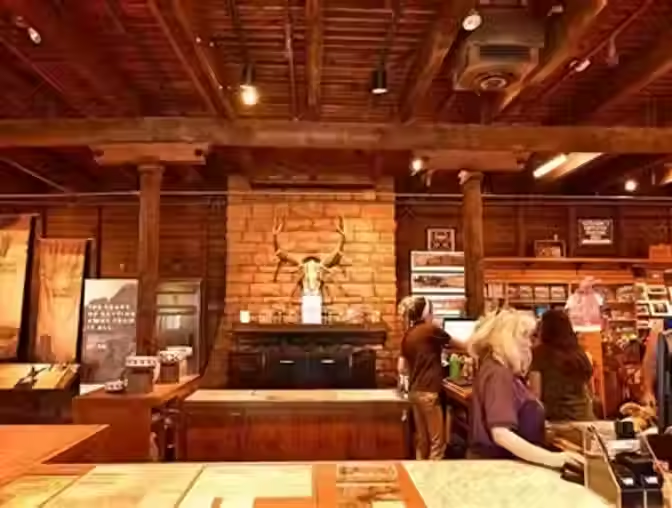
The Visitors Center contains a display about the park and a gift shop.
If you have kids ages 4 and older, pick up a Junior Ranger activity book for each of them. This activity is FREE! and books are gauged to the age of the child.
Books are also available at one of the park's visitor centers, backcountry ranger stations, or Grand Canyon Conservancy bookstore. Specialized books are available for the North Rim, South Rim, and Canyon Explorers.
The Grand Canyon Junior Ranger books are designed with place-based activities to be completed on a visit to the park. If you are visiting the South Rim and need a screen reader accessible or fillable PDF version of the South Rim Junior Ranger book, please download that here.
Bring along some pencils, colored pencils and a clipboard for each and keep the kids entertained completing the book to become a Junior Ranger. When they've completed their book, return to the Grand Canyon Visitor Center, the Verkamp Visitor Center or the Tusayan Museum and when the kids review it with a park ranger or staff member they will be awarded a Grand Canyon Junior Ranger badge.
You must be in the park in order to receive a badge, they cannot mail Junior Ranger books or badges.
Matt and Cheryl have a website called We're In the Rockies that focuses on travel destinations in the West that's absolutely top notch. They did the following video for kids on the Junior Ranger Program.
The Verkamp's Visitor Center is typically open between 8 a.m. and 7 p.m. daily, though hours may vary by season.
Begin your tour of the village from the Visitor's Center so that if you have kids, you can get them started on Junior Ranger program as we tour the Village together.
Grand Canyon Village is divided into three districts: the Market Plaza, the main Visitor Center and parking lots; and the Historic District. The Historic District was the original hub along the South Rim (thanks to the arrival of steam-powered trains in 1901), as such it's home to several historic buildings that are now utilized for dining and lodging, including Verkamp's Visitor Center, the El Tovar Hotel and the family-friendly Bright Angel Lodge. For visitors who want to stay overnight in the park, reservations at these iconic lodges need to be made well in advance. (A year in advance, currently)
From the Visitor's Center, continue to tour the Village in a counter clockwise direction so that you arrive back near the Tover Hotel and railroad depot for your 3 pm train boarding back to Williams.
Hopi House


The typical ceiling of the Hopi style: saplings, grasses, and twigs with a mud coating on top, resting on peeled log beams
From the Verkamp Center walk over to the Hopi House. Even if you're not in the market to shop for some Native American-made wares the interior of Hopi House is worth seeing, especially the thatched ceiling which is made in the traditional Hopi manner. Luckily for all of us, they didn't recreate Hopi House 100% authentically or we'd be crawling through a hole in the roof to enter the building rather than walking through a front door.
Buckey O'Neill Cabin
Your next stop will be the Buckey O'Neill Cabin.

Photo credit: NPS
This cabin is the only remaining building from the early pioneer settlement era of the Village. Built on this site in 1895 by William Owen "Buckey" O'Neill, the 2-room office and bunkhouse—complete with v-notched logs, rough mortar chinking, and a native stone chimney—was the rustic home of Buckey and his wife while they operated a small hotel on the South Rim. The consummate entrepreneur, Buckey improved the Bright Angel Trail and camp at Indian Garden and promoted the Grand Canyon Railroad to benefit both his tourism and mining interests.
Buckey O'Neill died in Cuba in 1898 during the Battle of San Juan Hill, fighting with Theodore Roosevelt's Rough Riders. After his death, the cabin changed owners several times and was razed by the railroad and the Fred Harvey Company to replace it with the Bright Angel Lodge. The architect of the re-built Bright Angel Lodge and its cabins, Mary Elizabeth Jane Colter renovated Buckey's cabin as a guest cabin that is part of Bright Angel Lodge's guest cabins to this day.
Lookout Studio
Your next stop on our walking tour will be the Lookout Studio,

Photo credit: Whit Richardson
Visitors to the Grand Canyon today may stop in the Lookout Studio just west of the Bright Angel Lodge to buy gifts, books, professional photos or other creative items. Be sure to walk out onto the deck and look through the telescope.
Afternoon: Stop for lunch at any time. There are several restaurant options available. Just know that in-park dining (apart from fine dining) is just that when it comes to quality: in-park dining.
Kolb Studio
Continue on to the Kolb Studio.

Photographers Emery and Ellsworth Kolb helped turn the Grand Canyon into a national icon. They built Kolb Studio, one of the earliest tourist destinations on the South Rim. The brothers began to take photographs of the mule riders from a small toll shack on the Bright Angel Trail. The toll shack would later become today's five story home, theater and photo studio built right on the edge of the canyon! The studio was used to document the trips of visitors and create imagery of Grand Canyon for 75 years.
Nearly demolished in the 1960s, this structure stands today as a park icon, art gallery, and bookstore for visitors in the vicinity of Bright Angel Trail.
Currently, visitors can purchase artwork, books, gifts, souvenirs, and basic hiking gear, or simply stop by for park information and exhibits on the Kolb Brothers' life and adventures on the edge of the canyon.
Bright Angel Lodge
Next stop on your tour: the Bright Angel Lodge.

Located right on the canyon's edge at the west end Village Historic District, the lodge was designed by Mary Colter in 1935, to resemble a rambling pioneer settlement with a variety of buildings that feature exposed timber, adobe and natural rock walls. The lodge has, two restaurants, a gift shop, lounge, fountain and coffee shop, a small museum, and a transportation desk, where mule trips and bus tours may be booked.
Bright Angel has 90 lodging units ranging from cozy historic units with shared bathrooms, to standard lodge rooms and historic cabins, to the one of a kind "Buckey O'Neill Cabin". Accommodations range from rustic cabins (with in-room coffee maker, satellite TV, and private bath) to lodge rooms (with no television and a shared bath). All rooms are equipped with telephone and refrigerator. Most rooms have only one bed and they are on the small side.
Please note: Rooms with canyon views are very limited and cannot be guaranteed.
El Tovar Hotel
The El Tovar Hotel is a curious mix of Southwestern and Norwegian architecture. But that's not the draw of the El Tovar - it's their dining room that serves world class gourmet breakfast, lunch and dinner.

The hotel itself is beautiful but I found a HUGE variance in price per night depending on the date you book - anywhere from $250 per night to $787 per night for the same room!
Santa Fe Railway Station

Many visitors in the early 1900s traveled by train from the East Coast and Midwest to see the fabled Grand Canyon for themselves—illustrated on postcards and written about by early explorers. In those days, the train brought tourists to the Grand Canyon Railway Depot, from which the Grand Canyon and El Tovar were just a jaunt away. Today, it still operates as a working depot, connecting visitors to the Grand Canyon Railway Hotel in Williams, a popular option for families planning longer stays in northern Arizona.
Mule Barn
While touring the Village you have to stop and see the Mule Barn so you know where it is.
The Mule Barn is located at 2 Mule Rd, Grand Canyon Village, Circled in red below.


The Grand Canyon Mule Barn, built in 1906, serves as the departure point for mule rides into the canyon and houses the mules used for these excursions.
The Mule Barn is a historic structure located at the South Rim of the Grand Canyon, constructed in 1906 by theFred Harvey Company. Originally built as a livery stable for horse-drawn carriages serving the El Tovar Hotel, it was later converted to house mules that transport visitors and supplies along the canyon's trails, particularly the Bright Angel and South Kaibab Trails.
Today, the Mule Barn is operated by Xanterra Travel Collection and remains a working facility. It is the starting
point for various mule rides, including the popular Canyon Vistas ride, which offers a scenic experience along
the rim, and the overnight ride to Phantom Ranch, which takes riders down to the canyon floor. Visitors can
observe wranglers saddling up the mules each morning, and while interior access is restricted, the exterior
corral provides a glimpse into this living piece of history.
Mather Point

Located steps from the main visitor center, Mather Point is the first view many visitors see of the Grand Canyon. Travelers can take an easy, five-minute walk on its sidewalk from the Grand Canyon Visitor Center to the lookout. Its fenced overlook provides exceptional vistas of the rugged cliffs and trails below. If weather conditions are right, visibility exceeds 30 miles to the east and 60 miles to the west. Mather Point is also a popular spot to watch the sun rise and set over the canyon.
Take the short walk to Mather Point to get your first view of the Canyon.
At 3 pm you'll reboard the train to take you back to Williams.
Evening: Dinner at Miss Kitty's Steakhouse. 642 East Route 66, Williams, AZ.


For many travelers, Miss Kitty's Steakhouse offers exceptional value, with generous portions and well-priced dishes earning high praise. The food, particularly the steaks and house-made sides, is often celebrated for its delicious flavor and thoughtful preparation.
The warm and attentive atmosphere by staff made us feel valued as customers as soon as we walked in the door. The decor is classy with western touches yet keeps with the Route 66 area theme.
We both had steaks that came out perfectly cooked to order and were melt in your mouth delicious. My wedge salad was nearly the size of an entire head of lettuce. My loaded baked potato couldn't have been more loaded - just the way I like it.
Prices were reasonable.
Grand Canyon IMAX Theater

The Grand Canyon Visitor Center IMAX and IMAX® Theater provide the perfect start to an amazing Grand Canyon adventure.See "Grand Canyon: Rivers of Time" in IMAX® on a giant 6-story-high screen and discover in only 35 minutes a Grand Canyon that would take a lifetime to experience. "Grand Canyon: Rivers of Time" is the winner of the Best Visual Effects award among giant screen films in 2023. The Grand Canyon IMAX® Theater now features IMAX® with Laser technology – a next generation laser projection system and 12-channel sound system exclusive to IMAX® theaters.
A sneak preview...
This film was excellent, I wish I'd seen it sooner. It covered the Spanish conquistadors and frontiersmen and their interaction with the Native American tribes, and the exploration of the Colorado River. The narrative unfolds with the first photos taken of the Grand Canyon in 1872.
The film also delves into Native American mythology and the cultural heritage of the region.
The photography is beyond stunning. The film is designed to appeal to a wide range of viewers, from families to nature enthusiasts, and is often featured in IMAX theaters.
The Grand Canyon Visitor Center IMAX, is located 7 miles from the South Rim in Tusayan just outside the Grand Canyon National Park.
Showtimes are on the half hour, one screening per hour. Tickets flexible for any showtime.
Tickets are regularly $15.25 but currently $12.20. Children 5 and under admitted free when accompanied by a paid adult.
If you see this film early in your trip you'll have a much better understanding of what you're seeing in and around the Grand Canyon.


Morning: We had breakfast in Williams where we were staying...you choose a breakfast restaurant near where your accommodations are.
We had breakfast at Anna's Canyon Cafe.
137 W Railroad Ave, Williams, AZ in the Red Garter Inn.

This restaurant features friendly service, a large menu, and delicious food. You can have everything from breakfast, lunch, and dinner in a number of styles—including Mexican, Asian, and classic American cuisines. It is an affordable option for groups of all sizes, any time of day.
The restaurant evokes the feeling of being in an old time saloon. What was really cool is a laminated map of the world hanging in the main dining space. Restaurant owner Anna Dick has long had this map in her establishment. Guests are encouraged to mark their hometowns on the map. You’d be amazed at all the different places people have traveled from to eat at the Grand Canyon Coffee and Café.
A shaded, pet-friendly patio can be found right next door to the building. WiFi is available.
Grand Canyon Village
Return to the Village to explore anything you didn't get a chance to see yesterday. You can explore until 10:30 a,m. at which time you're to go to the Bright Angel Lodge's transportation desk.
Note: You'll have to have made reservations to do this before your trip!
Then on the day of the ride you reconfirm your reservation at least two (2) days prior to your tour date by calling (928) 638-3283.

Bright Angel Lodge transportation desk / Photo credit: We're In The Rockies
Canyon Vista Mule Ride
Saddle up! We're going on a mule ride! It's your only opportunity to go down into the Grand Canyon itself.


This video by Cheryl of We're In The Rockies does a great job of explaining everything about the mule rides.
Yes, your mule will hug the edge of the cliff during the ride, I don't have the best track record when it comes to horses or anything resembling them (like mules) and the first time I looked over the cliff edge my heart went into A fib. Mules are used because they're so sure footed and strong. Trust your mule! They've done the walk so many times they could walk it in their sleep! Just remember "No leanin' no screamin' " and you'll be fine. Once I learned I could trust my mule I relaxed and had a great time on the ride.

Mules hugging the edge of the cliff
The ride we'll be taking is called the Vista Mule Ride and it's 2 hours long. During the ride you'll stop briefly 6 times as your trail guide shares information about the Grand Canyon with you. You must check in for the ride so early because you'll receive instruction as to how to ride the mule.
Cost ranges between $60 to around $2000 for the overnight trip down to Phantom Ranch. Our 2 hour Vista ride cost $193 each, including tax and surcharges. The ride was worth every cent and you'll get an entirely different perspective of the Grand Canyon being away from the tourist crowd, riding on the canyon rim.
The Mule Rides depart at 8:00 a.m. and 12:00 p.m. (you must check in by 6:30 a.m. and 10:30 a.m. respectively).
RESERVATIONS — Mule rides may be reserved by calling 1-303-297-2757 or toll-free within the United States at 1-888-297-2757. Reservations can also be made online here. You must have reservations.
Mule riders should plan to provide their own rain gear as necessitated by local weather forecasts. All mule riders are required to reconfirm their reservations at least two (2) days prior to your tour date by calling (928) 638-3283. Guests are strongly encouraged to check-in to the Bright Angel Transportation Desk the day prior to their ride. If unable to, guests are required to at check-in at least 90 minutes before the tour departure time.
The trail you rode down into the Canyon on the mule is the Bright Angel Trail. You can hike this trail as well but it's a difficult hike - an approximately 12 mile hike round trip. Avoid making the full trip during the summer, as you may put yourself at risk of heat exhaustion. Still, there are shady spots along the trail and rest houses that provide water for thirsty hikers. Bright Angel Trail is the most popular trail in the park.
Other things you need to know about the mule ride:
-
Any rider must weigh under 225 pounds (including clothing and shoes worn) and you will be weighed. If you are as much as one pound over that limit, you will not be allowed to ride and they will refund your money. This is done for both the safety of the rider and the mule.
-
Riders must be at least 9 years old and at least 4 feet 9 inches tall.
-
Riders are limited to groups of 20. You may be split into 2 groups of 10 riders.
-
You have to wear pants, tennis shoes or boots, and a hat or helmet that attaches. You can purchase these items in the gift shop. (They don't want anyone dropping anything down into the canyon.)
-
These mules are trained for city-slicker riding-no experience required! No one in our group regularly rode horses. A few of us had been on some other horseback rides.
In total, the tour will last 3 to a little over 3 hours, with 2 of those hours spent in the saddle. You'll return to the Village sometime around 3 pm so have some time to explore before dinner.
When you return to the Village, you have the option of hopping the free red line shuttle to ride to Hermit's Rest if you'd like to see it before dinner.
Hermit's Rest
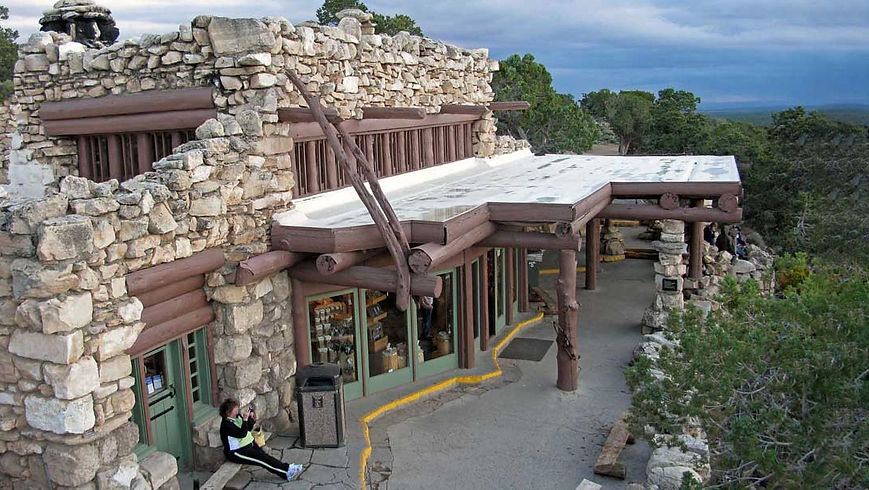
Hermits Rest, constructed in 1914 at the end of Hermit Road as a rest stop for carriage tours
Several miles to the west of Hopi House, is an entirely different type of structure. Hermit's Rest. The building, originally constructed as a rest stop for the short stage line that ran from El Tovar to this location, is a stone building placed several feet back from the rim edge, and is tucked into a small man-made earthen mound, built around and atop the building to blend it in with its setting.
In Grand Canyon Village near the Bright Angel Lodge board the Red Line shuttle and ride it to Hermit's Rest.
Hermit's Rest was designed to resemble a dwelling constructed by an untrained mountain man using the natural timber and boulders of the area. From the entrance path a haphazard looking structure of stone and wood greets the visitor, and the approach to Hermit's Rest is marked by a small stone arch set in a stone wall along the original pathway from the parking area to the building. The exposed portions of the building that are not banked into the earth are of rubble masonry bonded with cement mortar, structural logs, and a few expanses of glass. The chimneys are gently battered rubble masonry. The first thing I wondered when I saw it was how it was still standing!
Horse-drawn carriages, and later automobiles, operated by Fred Harvey, carried visitors on scenic tours along the Hermit Road, dropping them off here for a respite before the return trip to Grand Canyon Village.
Hermit's Rest was built to resemble an old miner's cabin with native stonework, a giant alcove fireplace, and front porch. It presently offers a gift shop, snack bar, and west end views of Grand Canyon. Restrooms and a water bottle filling station are available outside, behind the main building.
The red line shuttle ride to Hermits Rest offers a variety of scenic views along the Hermit Road. Here are
some of the highlights you can see during the ride:
-
Trailview Overlook: Offers views of the Bright Angel Trail and the Village from the top of the cliff.
-
Maricopa Point: Provides 180° unobstructed views facing northeast, including a glimpse of the
-
Colorado River.
-
Powell Point: Features expansive views and a memorial commemorating Major John Wesley Powell.
-
Hopi Point: Offers views of the Colorado River and the canyon's natural beauty.
-
Mohave Point: Provides views of the canyon's cliffs and the Colorado River.
-
The Abyss: A dramatic viewpoint with stunning views of the canyon.
-
Monument Creek Vista: Offers views of the canyon's cliffs and the Colorado River.
-
Pima Point: Provides views of the canyon's cliffs and the Colorado River.
El Tovar (Restaurant)
The El Tovar's restaurant is the premiere restaurant in the Grand Canyon, having served the likes of Teddy Roosevelt, Paul McCartney, Bill Clinton, Oprah Winfrey and Albert Einstein.
Reservations are now required for both lunch and dinner and are highly recommended for breakfast as well.
Online reservations can be made here.
I recommend having at least breakfast there and ordering the Peach Melba Belgian Waffles.
Dress Code: El Tovar Dining Room is a classic, fine dining experience. While jackets are not
required, please use discretion to dress appropriately (shorts and flip-flops discouraged).
We did love the atmosphere - this celebrated and majestic Dining Room is constructed of native stone and Oregon pine. The murals on the walls reflect the customs of four Native American Tribes – the Hopi, the Apache, the Mojave and the Navajo. The ambiance is rustic but classic and traditional.

We didn't get our hopes up being all too familiar with National Park food. We ended up eating there twice for dinner and once for breakfast. It wasn't bad at all for park food!

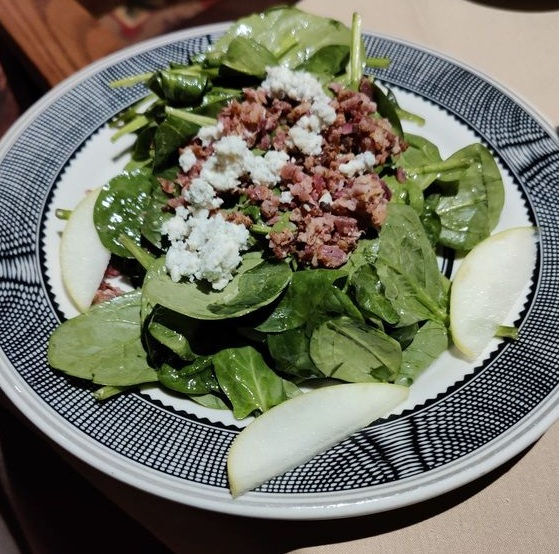


We had spinach salad, house salad, Navajo tacos, bison steak, orange glazed duck, prime rib and beef stroganoff. Oh - and peach melba waffles for breakfast. All was much better than we expected it to be. I won't say it's the best meal we ever had but it was far, far from the worst. Service was decent given how busy the restaurant was, we had no complaints with the service.
The prices were less than we expected them to be. The most expensive item on the menu was $68 (Filet Mignon) but most dinner entrees were in the $22 to $36 range.
You must have reservations for dinner and now lunch but they're recommended for breakfast too.
Hours of Operation
-
Breakfast – 6:30 a.m. to 10:00 a.m.
-
Lunch – 11:00 a.m. to 2:30 p.m.
-
Dinner – 4:30 p.m. to 9:30 p.m.
-
Lounge – 11:00 a.m. to 10:00 p.m. (Food until 9:30 p.m.)
-
Beer Garden and Patio – Closed until Spring 2026
Hours vary seasonally and may be extended during peak seasons.
After dinner return to your accommodations and rest up for tomorrow.


Morning: Breakfast at Pine Country Restaurant.
107 N Grand Canyon Blvd, Williams
Confession: We chose this restaurant because a Williams local told us they had homemade pies that were out of this world. And we intended to snap at least one of those babies up for later that evening. Or maybe one each of the 16 different varieties after we discovered the first pie
not only melted in our mouths, it signed a lease there.
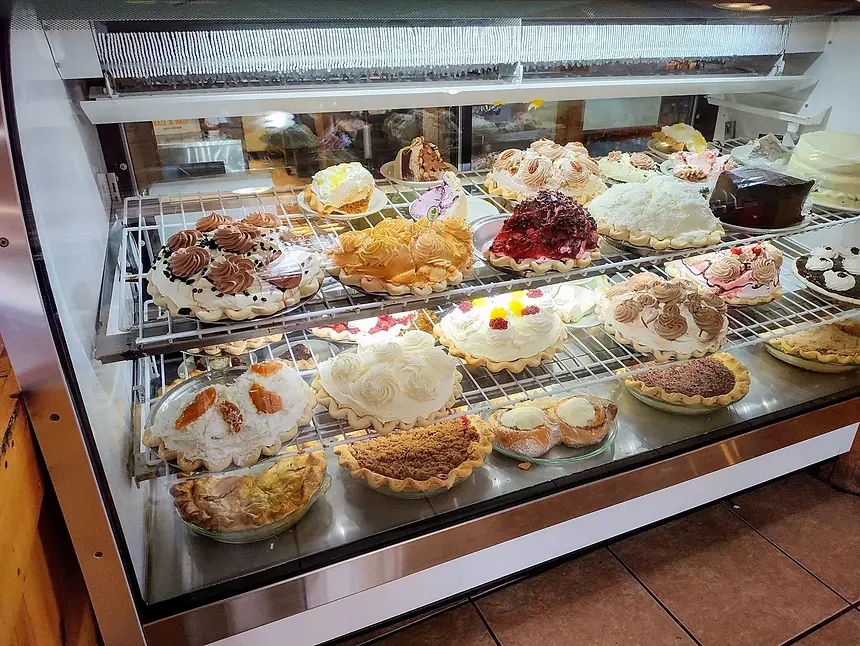
The Pine Country Restaurant pie display case
For my breakfast I ordered a Navajo taco - singular. I was fairly certain that what came out of the kitchen had RSVP'd to its own block party. I nearly gave it a standing ovation.

The Navajo Taco

Jay ordered a steak breakfast which he described as "heavenly". I think he meant it literally because he appeared to be having a religious experience, at one point speaking in tongues.
And then the Rapture...the pie. OMG THE PIE!

One thing I do have to warn you about though...watch out for the crows outside.
These aren't your average birds. These things are the size of a Wandering Albatross and are smart enough to do your taxes for you.
They'll stare at your pie as if staring into your soul, barely waiting long enough for you to leave a single pie crumb on your plate before divebombing in to claim their share.
Apart from those gigantic crows, Pine Country is a FANTASTIC restaurant. Even if their pies will send your blood sugar levels soaring into the next galaxy.

Biking the Grand Canyon

Biking the Grand Canyon is one of the best ways to see it, with various trails and rental options available if you don't want to bring your own bike.
Biking Opportunities

and the Greenway Trail...

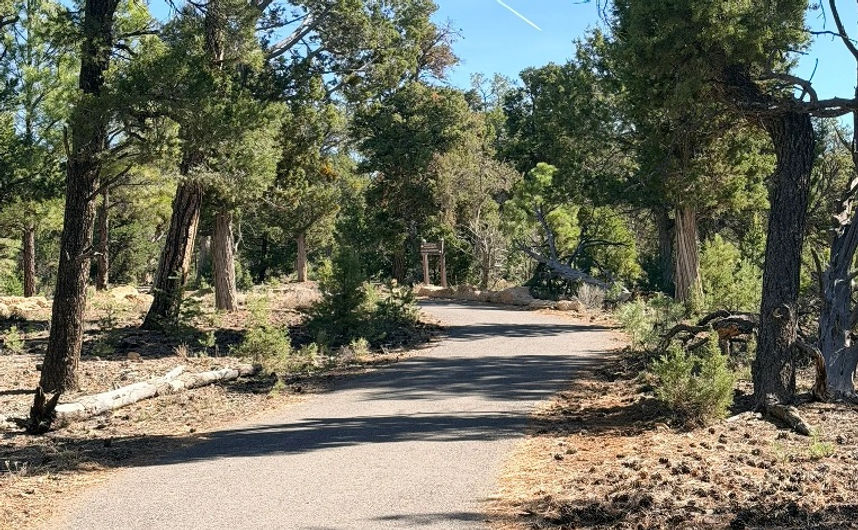
Greenway Bike Trail

Best Times to Bike: The ideal seasons
for biking in the Grand Canyon are
spring (March to May) and fall
temperatures are milder. Summer can
be extremely hot, while winter may
present icy conditions on some trails.
It's advisable to wear a helmet and bright clothing as in places you'll be sharing the ride with vehicular traffic, carriages, horses, and even wildlife.

Located near the Visitor Center, Canyon Adventures Bike Tours & Cafe is the only bike shop within the park, offering bike rentals, including e-bikes, and refreshments. This is a convenient option for those looking to explore the area without bringing their own bikes.
Bicycling and E-Bike Information: Natl. Park Service
We biked the Greenway - VC to Village trail this particular morning.

The Greenway from the Grand Canyon Visitor Center to Grand Canyon Village is a paved trail that offers a
scenic route for biking and walking. It is part of the Grand Canyon Greenway Trail system, which totals 13
miles of paved pathway for biking and walking. The trail provides access to numerous scenic viewpoints and attractions within the park.
The trail is open to bicycles and Class 1 and Class 3 e-bikes. It is a popular route for birding, running and snowshoeing and is open year-round. The trail is approximately 4.9 miles long and has an elevation gain of 259 feet. It typically takes about 1.5 to 2 hours to complete.
The trail surface is asphalt and typically at least 4 feet wide, with an estimated grade of moderately steep (8% or less).
TrailLink.com offers an interactive GIS map and additional trip-planning information for visitors.

Sunset on the Grand Canyon Greenway Trail
Afternoon: Lunch at Desert View Trading Post. Desert View Rd, Grand Canyon Village.

Located in the Grand Canyon, Desert View Trading Post is a convenient stop for visitors looking to grab a quick bite or indulge in some sweet treats. The trading post offers a variety of snacks, including Indian tacos and hot dogs, as well as hand-scooped ice cream and homemade fudge. In addition to refreshments, visitors can browse through locally made rugs and artisan crafts, making it an ideal spot to pick up souvenirs.
Desert View Drive

Take a drive down scenic Desert View Drive.
The Desert View Drive portion of SR 64 is a 23 mile scenic road that begins near Grand Canyon Village. Private vehicles can drive east along the canyon rim for 23 miles (37 km) to the Desert View Services Area, and the East Entrance of Grand Canyon National Park.
What's Along the Desert View Drive portion of SR 64:
-
Six developed canyon viewpoints
-
Four picnic areas
-
Five unmarked pullouts
-
Tusayan Pueblo Archaeology Site: CLOSED
Opens April 2, 2026, Thursdays through Mondays: 8 am to 4 pm.
Desert View Drive begins at Mile Marker 241.5 - at the junction with South Entrance Road.
Keep in mind that Grand Canyon shuttle buses do not travel on Desert View Drive, so you will have to drive yourself. The closest you can get via shuttle bus is the first viewpoint of the canyon along Desert View Drive – the Pipe Creek Vista; the Kaibab Rim (orange route) stops here.
The area is open 24/7, though visitor services have set operating hours. There is a seasonal campground in the area, though no formal lodging. Other services include a market, a trading post and a gas station. You'll find the beginning of Desert View Drive at mile marker 241.5 at the junction with South Entrance Road.
Perched along the canyon's rim, the centerpiece of Desert View is the Desert View Watchtower, architect Mary Colter's 1932 building that incorporated design elements of the Ancestral Puebloan people of the Colorado Plateau. Inside, the Kiva Room offers seasonal cultural demonstrations where visitors can learn about the arts and crafts of Native American groups of the area.
Evening: Pack an overnight bag. We're going to drive 2.25 hours to Peach Springs, AZ to stay overnight at the Hualapai Lodge - the only accommodation in Peach Spring. You can either grab dinner enroute on the road or have dinner at Hualapai Lodge's restaurant.
HUALAPAI LODGE
 |  |  |
|---|---|---|
 |
We're going river rafting tomorrow morning! We're paddle whitewater river rafters but there were no paddle rafting trips running at the time so we had to settle for a motorized raft trip on Class 3 to 5 rapids.
Class 3 rapids are considered intermediate in difficulty, characterized by moderate to medium-sized waves, typically two to three feet high. They are generally suitable for paddlers with some experience, as
they require some maneuvering and can be more challenging than Class II rapids.
River Rafters offer discounted rates for the lodge and can book rooms for you. You can make these selections when completing your booking form here.
The trip begins with a 7 a.m. check in and returns between 5 and 7 pm, concluding at Lees Ferry, the entrance to the Grand Canyon.


The trip begins with a 7 a.m. check in and returns between 5 and 7 pm, concluding at Lees Ferry, the entrance to the Grand Canyon.
On the day of your whitewater adventure, the excitement begins at 7:00 a.m. as you check in with the Hualapai River Runners in the lobby of the Hualapai Lodge in Peach
Springs, Arizona (Grand Canyon West). From there, prepare for an exhilarating descent as you board a bus that takes you on a thrilling one-hour journey down the rugged terrain of Diamond Creek Road. As you wind your way down, you'll experience a dramatic drop in elevation, plunging over 2,000 feet into the heart of the Grand Canyon. The adventure truly begins as your motor rafts launch from Diamond Creek, right at its confluence with the mighty Colorado River. Following a brief orientation and gearing up with PFDs and dry bags, you'll embark on the river. Your first stop is Travertine Falls, where you can optionally hike up ropes and ladders to explore a cave. After departing the falls, you'll continue rafting until it's time for a beachside lunch. Post-lunch, you'll enjoy a smooth water float through the Grand Canyon, soaking in the serene landscape. You will be lifted out of the canyon via helicopter and driven back to Peach Springs via bus.
The clear and refreshing waters of Travertine are always a welcome experience for river runners.
After an initial cool-off in the creek and falls, for those who are up for it, a scramble with a little help from ropes and ladders, leads hikers into a magical grotto.
Once in the grotto, there is plenty of room for everyone to enjoy the marvelous spring water and stand under a waterfall as well, which cascades down from the top of the grotto.
Take extra caution on the hike down, as it is easy to make a misstep.
Even though we weren't paddling we had a blast.

Travertine Falls
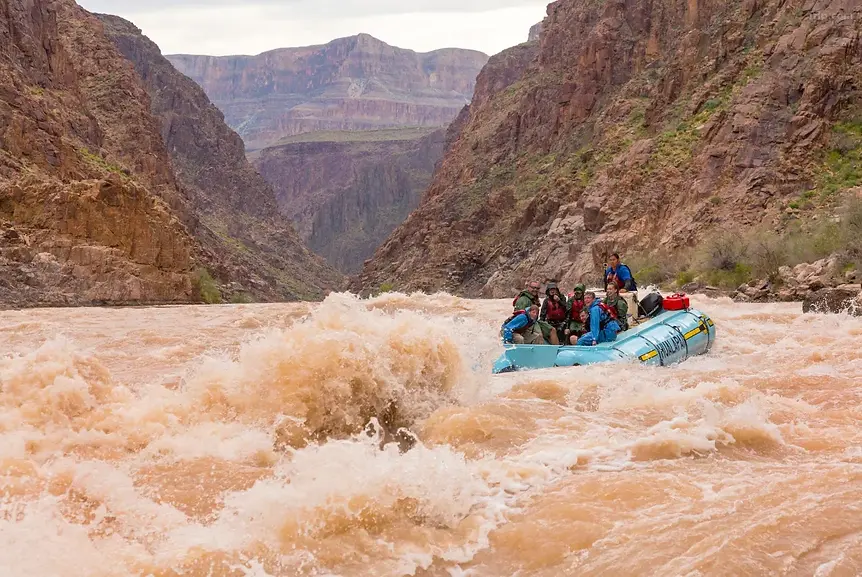
Rafting trips aren't inexpensive. The current cost for kids aged 8-12 and adults is $589, not including tax and gratuity.
For those looking for additional savings, it's worth checking back regularly as discounts vary regularly. The company guarantees the same price as booking directly with the outfitter, and they provide expert advice at no extra cost.
What's included in the trip?
Lunch: Deli-style sandwiches with chips, fruit, cookies, trail mix, snacks, water, and soft drinks.
Lifejackets
Dry Bags: for personal gear per group
What should you pack?
*While On Raft:
*Poncho or Rain Jacket (Optional)
*Light Weight Apparel: Dry Fit Shirt and/or Long Sleeve
*Fast Drying Shorts and/or Pants
*Water Shoes, River Sandals, or Old Sneakers
Backpack
Extra Pair of Clothes (Shorts, T-Shirt, Undergarments, Socks)
Water Shoes, River Sandals or Old Sneakers (these will get wet)
Personal Towel (Optional)
Camera/Phone/Electronic Device (Bring at your own risk)
Cash/Card
Sarong
Neck Gator
Large Hat with Strap
Sunblock (SPF 30+) and Aloe Vera Lotion/Gel
Chapstick (SPF)
Bug Repellent
Wet Wipes
At the conclusion of your raft trip you can get some dinner at a cafe on the drive back, then return to your accommodations for the evening to rest.


Last day of our Grand Canyon trip.
Morning: Breakfast at El Tovar Restaurant. Don't forget to try their waffles!

Today is a free day that you can do whatever you haven't yet done that you want to do or see what you want to see before leaving the Grand Canyon.


Lauded by travelers as one of the most beautiful sights in the area, Havasu Falls is a desert oasis, complete with blue-green water and gushing falls. The ethereal pools formed by Havasu Creek add an almost surreal quality to the red canyon backdrop. Though it's often associated with the Grand Canyon, this site is not located within the national park; it sits on the Havasupai Indian Reservation. The season for visiting the falls runs from February to November.
I'm glad I saw the Falls on a previous trip. Since then the Havasupai tribe requires you to first secure a three-night overnight reservation to enter the area prior to their visit. Reservations, which go live for the official season on Feb. 1 at 8 a.m. MST, include the required access permit and a camping fee; $455 per person for the trip. No day trips are allowed, and campers need to be prepared with supplies to eat and sleep in a wilderness campground.
This is ridiculous. Why should one need to buy not only the required access permit but a $455 per person camping fee to spend maybe an hour seeing the Falls?!! Why discontinue day trips since that is what most travelers would be interested in doing? There's no waterfall worth seeing that I'd pay $455 to see, not even Niagara Falls. Havasu Falls just isn't THAT remarkable.
It's a 2+ hour drive to Havasu Falls from the Grand Canyon Village and I didn't want you making that drive only to arrive at the reservation and find out then that you'd have to pay a small fortune to see the Falls.