
Updated March 13, 2026
I made quite the impression on my first trip to Williamsburg as a high school sophomore. Who incidentally, was on the track team.
For some unknown reason there was a horde of shoulder-to-shoulder people in front of the Capitol that day.
I'd gotten separated from my family in this crowd, spotted them, so took off at a dead run to reunite with them before I lost them in the crowd again.
Enroute, I plowed into a lady I took to be from India and accidentally knocked her to the ground. Suddenly I was being grabbed by four big burly guys.
"LET GO OF ME!" I hollered, trying to pull away from them.
I held my hand out to the woman I'd just unceremoniously planted on the ground while apologizing to her.
The four big burly guys slapped my hand away like DO NOT TOUCH HER!
Alrighty then., have it your way. I took off at a dead run again and managed to catch up to my family before I lost them in the horde again.
I'd no sooner rejoined them than my dad asked me "Did you see the Queen of Nepal?"
OOOPS!
That's right, I'd knocked the Queen of Nepal right smack on her royal a**.
Which her bodyguards took none too kindly to, I might add. (She however, was very gracious about the whole incident.)
On my next two visits to Williamsburg I made sure she nor any other royalty were visiting - just to be on the safe side.
Royal SNAFU's aside, I love Williamsburg. It's one of my all time favorite places to visit. I couldn't wait for Ashley to see it.

My tips for visiting Williamsburg...
Williamsburg comprises 301 acres of things to see and do. You cannot possibly see it all in one day. Plan at the very least, 3 days at Williamsburg.
Be prepared to spend the extra buck to see everything, for its through visiting all of the shops and taking guided tours that you'll really come to understand what colonial life was like.
Don’t skimp trying to save a few dollars when visiting Williamsburg by listening to some other websites out there that say you can see plenty on your own; the admission pass opens up the history that is on offer here.
Wear your most comfortable walking shoes! Believe me, by the end of the day you'll be limping along at a snail's pace even in your best walking shoes! Similarly, bring clothes you can layer. The weather can change abruptly. Make sure you bring some kind of sun hat because it can be beastly hot in the summer.
Tip for parents: Save yourself a whole lot of grief and get the kids colonial costumes before you even set foot in Williamsburg! There are shops in Williamsburg that rent and sell them but you'll pay premium price for them. We drove my poor dad nuts begging him to at least buy us tricorner hats, until he got so sick of listening to us that he broke down and bought them for us just to save his sanity.
There's a reason Williamsburg sells and rents kids colonial costumes!
If you don't want to buy the kids costumes then invest in a really good pair of earplugs.
Amazon carries colonial costumes.
The parking fees at Colonial Williamsburg are as
follows:

No automated vehicles are allowed inside Colonial Williamsburg: it's walk or take a carriage ride and the free shuttle where available.

To get transportation to Colonial Williamsburg, you have several options:
-
Visitor Center Shuttle: A complimentary shuttle bus runs from the Visitor Center to the Historic Area, stopping at key attractions like the Governor’s Palace and the Art Museums of Colonial Williamsburg.
-
These options provide convenient access to Colonial Williamsburg from various locations.

Dining in Williamsburg is an experience in itself, especially feasting on traditional Colonial foods.
Williamsburg has a variety of restaurants including table service and Grab & Go restaurants. Reservations are recommended for all table service restaurants, particularly the Taverns: Chowning, Christiana Campbell's, King's Arms and Shield Taverns.
Besides the taverns there are several table service restaurants within Williamsburg:
-
Terrace and Goodwin Rooms
-
Sweet Tea & Barley
-
Rockefellers
-
Restoration Bar
-
Traditions
-
Gold Course Grill
-
Museum Cafe
The Grab & Go establishments are:
-
McKenzie Apothecary
-
The Cupboard
-
Dubois Grocer
-
Raleigh Tavern Bakery
-
Chowning's Garden Bar
-
Chowning's Cider Stand
-
Green Course Clubhouse Bar
Best Family-Friendly Restaurants in Williamsburg & the surrounding area:
1. Chowning’s Tavern (Colonial Williamsburg)
-
Offers a fun, casual colonial dining experience.
-
Kids will love the 18th-century-style games and music.
-
Menu includes hearty pub fare like meat pies and sandwiches.
2. King’s Arms Tavern (Colonial Williamsburg)
-
Historic setting with servers in period costumes.
-
Family-friendly meals, including roasted chicken and macaroni pie.
-
A great way to experience dining as it was in colonial times.
3. Christiana Campbell’s Tavern (Colonial Williamsburg)
-
Seafood-focused colonial-style restaurant.
-
George Washington was a fan of this tavern!
-
A fun experience with candlelit tables and live music.
4. The Cheese Shop (Merchant’s Square – Near Colonial Williamsburg)
-
Famous for delicious sandwiches and homemade bread.
-
Great for picnic-style lunches before or after exploring.
5. Food For Thought (Modern American – Kid-Friendly)
-
Offers a mix of Southern comfort food and healthier options.
-
Kids’ menu includes mac & cheese, grilled chicken, and mini burgers.
6. Mellow Mushroom (Pizza – Casual Dining)
-
Colorful, laid-back atmosphere with great pizza and salads.
-
Kids love the fun décor and unique toppings.
7. Captain George’s Seafood Buffet (Great for big eaters!)
-
A popular all-you-can-eat seafood buffet.
-
Offers crab legs, shrimp, and a variety of non-seafood options.
8. Shorty’s Diner (Classic Diner – Breakfast Favorite)
-
Fun, retro-style diner with great pancakes, waffles, and omelets.
-
Super affordable and great for families.
9. Pierce’s Pitt Bar-B-Que (Casual BBQ Joint)
-
A local favorite for smoked meats and Southern sides.
-
Great for families who love barbecue.
10. Duck Donuts (Sweet Treat!)
-
Customizable warm donuts with fun toppings.
-
A must-visit for a treat after exploring Williamsburg.
Adjust my itinerary as needed for you and your family, length of stay and if you have little ones, for their attention spans.
Here's a walking tour video and a map to familiarize you with Williamsburg's layout:
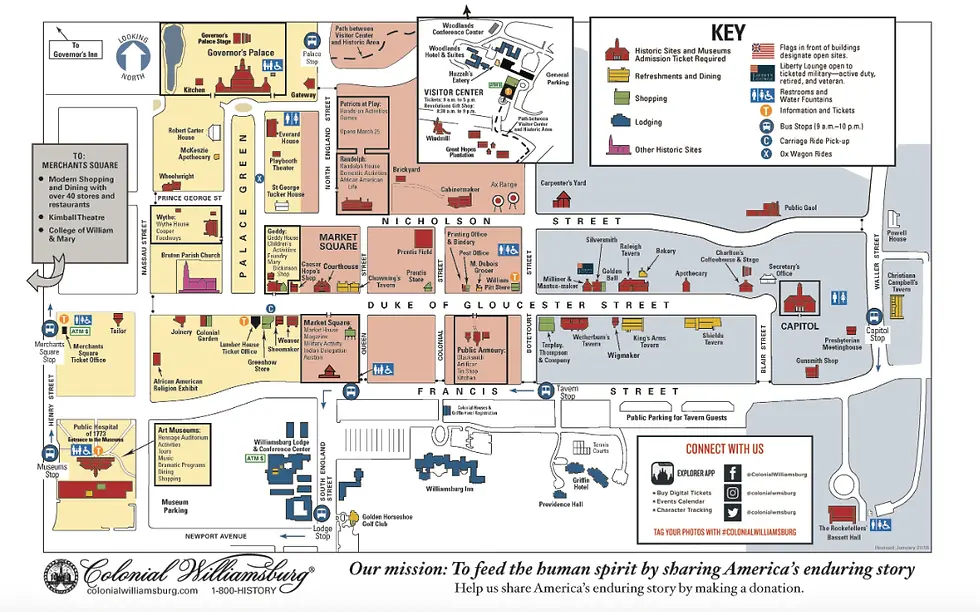
There are 3 main streets in Williamsburg: Nicholson Street, Duke of Gloucester Street and Francis Street.
Most of the attractions are laid out along these 3 streets, with Duke of Gloucester Street being the "main drag".
Before you visit Williamsburg download this self-guided walking tour utilizing a phone app - $13.49 per adult.
Here's another for $15, that shows you the exterior of 30 Williamsburg buildings. Some of the buildings are free to enter, some select ones require a n additional admission fee. By taking the tour first, you can select which buildings you'd pay to see the interiors of.
If you have kids, then I'd recommend booking the Pirate Walking Tour with Colin.

Yes, pirate tour.
Pirates (especially Blackbeard and his crew) played a significant role in the history of Colonial Williamsburg.
This tour will appeal to adults and kids alike. Colin is a walking encyclopedia on the subject of pirates and you can get an idea of the lay of Williambsburg while the kids are entertained with true pirate stories and history.
The price is the same for adults and kids - $25 each, the standard price for about any tour. The tour lasts 105 minutes and it is wheelchair accessible.
Be sure you specifically book with Colin because he is so knowledgeable and entertaining.

There are two options when visiting Williamsburg - staying inside Colonial Williamsburg or staying outside of Williamsburg for those with a tighter budget, and driving in each day. I've done it both ways but on my last two trips decided I liked staying at one of the Williamsburg accommodations since we were staying 5 nights.
We chose the Williamsburg Inn's most economical room and took advantage of a Stay More Save More deal - $328.18 per night plus taxes and fees, which I didn't think was at all unreasonable for the 500 square foot room we got - plus nightly turn down service, nightly tray and a rollaway bed for Ashley.
Amenities included:
-
Receive up to 2 complimentary length-of-stay tickets to the Historic Area when you book direct and become eligible for a discount on additional tickets.
-
Preferred reservations for our restaurants, appointments at The Spa of Colonial Williamsburg, tee times at Golden Horseshoe Golf Club, & tennis court times are available for all guests.
-
Use your admission tickets to take Williamsburg Area Transit Authority Buses around the perimeter of the Historic Area.


Park at the Williamsburg Visitor Center at 101 Visitor Center Drive.
The park will require you download an app for Passport Parking.
The cost to park at the Visitor Center is $10 per day and the app will allow you to take advantage of complimentary bus service to the Historic Area.
Admission Tickets: Williamsburg offers a variety of different admission ticket options to suit you and your family's individual needs. See ticket options here. If you book online, you'll currently save yourself 10%. Not all attractions/shops are covered under your admission ticket. Some buildings require a separate additional ticket.
On our first visit we purchased the America's Triangle Ticket that includes admission to Williamsburg, Jamestown and Yorktown. This ticket grants you access to five historic sites—including all of Colonial Williamsburg’s historic sites, trade shops, and museums—for seven consecutive days from first date of use. This was the most cost effective selection for us but it may be different for you and your family.
See the Williamsburg website for options.
The good news is that this year (2025) Williamsburg dropped their admission prices.
The Williamsburg Inn is intimate with just 62 guestrooms and suites. The Inn's guest rooms are decorated in three distinctive styles: floral, classic, and restoration. All rooms feature period furnishings, original artwork, and handmade silk window treatments.
There is an indoor exercise pool as well as an outside pool, tennis courts, a nearby golf course.
However, there are more budget conscious, family oriented options available. See all accommodations here within Colonial Williamsburg.
If you intend to stay at Williamsburg then be sure to check out their Special Offers & Packages page before you book reservations. There are several limited time discount packages available, plus you can get a Coupon Book which includes up to $350 in savings - worth its weight in gold when visiting Williamsburg.
If you elect to stay outside of Colonial Williamsburg itself, then investigate family friendly resorts like this one, $683 for 2 adults, 2 children for 5 nights in June 2026. Price includes tax and fees, book through Vrbo.
There are also the standard chain motels/hotels like Days Inn, Comfort Inn, Hampton Inn, etc. near Colonial Williamsburg if you're on a really tight budget - but be sure to check TripAdvisor and/or traveler reviews of the place before you book there.
Best Places to Stay in Williamsburg with Kids
1. Williamsburg Lodge (Official Colonial Williamsburg Hotel)
-
Steps away from the historic area.
-
Offers family packages and discounts on attraction tickets.
-
Outdoor pool and on-site dining.
2. Great Wolf Lodge
-
A kid favorite with an indoor water park!
-
Tons of activities, including a MagiQuest adventure game.
-
Perfect for families who want extra fun after sightseeing.
3. Kingsmill Resort
-
A luxury resort with pools, golf courses, and a kids’ club.
-
Located along the James River with scenic views.
-
Spacious suites and condos for larger families.
4. Embassy Suites Williamsburg
-
Offers free breakfast and spacious family-friendly rooms.
-
Indoor pool and close to local attractions.
5. Bluegreen Patrick Henry Square
-
Family-friendly suites with kitchenettes.
-
Walking distance to Colonial Williamsburg.
6. Woodlands Hotel & Suites (Colonial Williamsburg Resort)
-
Budget-friendly with free breakfast.
-
Kids love the splash pool and mini-golf course on-site.
-
Guests get discounts on Colonial Williamsburg attractions.
Day 1

We'll start right around the Visitors Center with the Great Hopes Plantation.

In the eighteenth century, nearly all Virginians lived on rural farmsteads. When people traveled to Williamsburg, the journey took them past many such small plantations. Those they met along the way-whites of modest means, free blacks, and slaves-were the most common inhabitants of Virginia.
Great Hopes is a recreation of such a Virginia farm. Historic farmers tend livestock, plant corn, wheat, and tobacco. Carpenters

prepare building materials. Interpreters undertake the many tasks that went with lives shaped by the land, the climate, and the season, and the institution of slavery.
The Plantation consists of several buildings and a windmill.
Walk back toward the Visitors Center (north) past Woodlands Hotel and turn south onto North England Street, then west to the Governor's Palace and Kitchen.
From the Governor's Palace walk straight south to the Palace Green.
For the Kids: Try Colonial Games on Palace Green
Kids can play hoop rolling, trap ball, and other 18th-century games on the Palace Green.
Free and fun, these games give children a taste of colonial childhood.
Visit the Thomas Everard House.
Everard was a wealthy planter and civic leader. One of the oldest houses in Williamsburg, the Everard House is furnished with 18th-century antiques and was meticulously restored to its early appearance.
214 Palace Green Street
Cross the Palace Green, go west on Prince George Street to the Wheelwright shop.

Cross Prince George Street to the Wythe House and Cooper shop.
Turn south onto Nassau Street, then east on Duke of Gloucester Street to Bruton Parish Church.
You're at the south end of the Palace Green and you'll see the Mary Dickinson Store, go north to the Geddy House, the Foundry and the Gunsmith.
GUNSMITH
Of course since we were fighting the American Revolution and people hunted for game, there had to be a resident gunsmith to make the guns. They were also needed for hunting to provide food and game for the colonists.
Continue past the Gunsmith to Nicholson Street, turn right (east) on Nicholson Street. The first building you'll come to is the Randolph House. The Brickyard is right next door to Randolph House.
For the Kids: There's a children's activity area between the Foundry and the Geddy House.
Afternoon: Turn back in the direction you came, go east on Duke of Gloucester Street, just past the Courthouse and have lunch at Chowning's Tavern: 109 E Duke of Gloucester Street. $
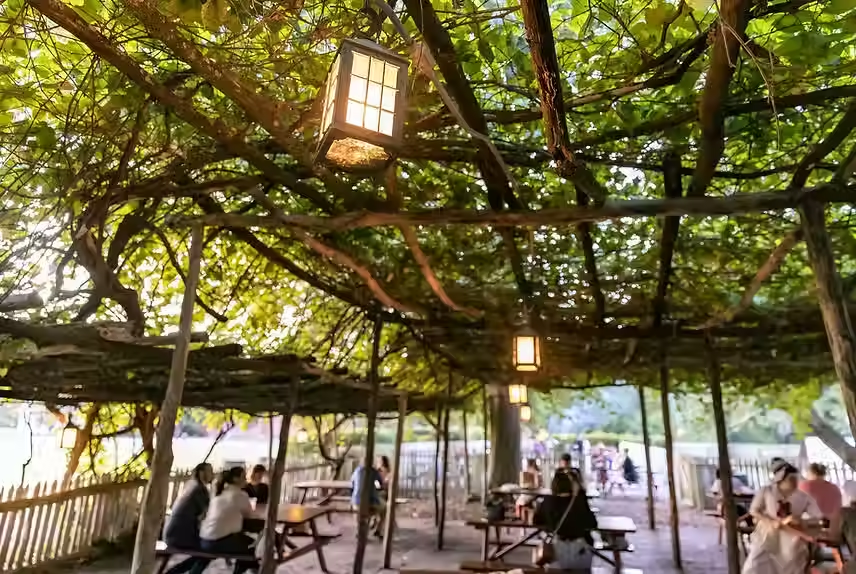
Tucked behind Chowning’s Tavern, Chowning’s Garden Bar offers a charming retreat that reflects the practical beauty of an 18th-century colonial garden. When we ate there it wasn't that busy and it was a peaceful retreat from the crowds and the food was good.
After lunch visit the Courthouse right next door.
From the Courthouse, continue walking west on Duke of Gloucester Street. You're going to be backtracking a bit here because there's an area of things to see on the south side of Duke of Gloucester Street.
Across from Breton Church:
TAILOR
THE JOINERY
THE COLONIAL GARDEN
Well, one of them anyway. There are 30 gardens in Williamsburg plus an arboretum.
If you can, take a guided tour of the gardens as they'll let the kids help them garden while teaching them colonial gardening methods.
The gardeners and farmers of Williamsburg are so interesting to watch working, using 18th century tools and gardening methods.
Plots within the garden represent provision gardens of the enslaved and American Indians, as well as the luxury gardens that ornamented the landscape of wealthy households.
The well-being of the entire colonial economy was dependent on the farmers' crops. This involves the growing and harvesting of tobacco, corn, wheat, flax, and cotton.
LUMBER HOUSE TICKET OFFICE
You'll also see the Lumber House Ticket Office in this area. Visit the Lumber House to purchase admission tickets, evening programs, and carriage rides.
You might want to take a break from walking and take a carriage ride if the kids feet (and yours) need a rest.

Lumber House Ticket Office
THE SHOEMAKER
THE WEAVER
When English imports were cut off by the Revolution, local weavers came forward to fill the need for everyday items. Watch how flax, cotton, and wool are converted from tangled masses into orderly, precise fabrics—ranging from simple linens for shirts and shifts to blankets, towels, dyed wool for needlework, and stout woolens for military uniforms.
If you've ever done weaving start to finish (flax to yarn to dying to constructing a garment) it's incredibly time consuming and laborious so you can really appreciate watching these weavers at work.
Last building in that section is
Evening:
Have dinner at King's Arms Tavern: 416 East Duke of Gloucester Street.
This is my second favorite Tavern in Williamsburg. $$$
Originally opened by Jane Vobe in 1772, this authentic reproduction public house serves up a transporting experience for the senses in Colonial Williamsburg. Everything is true to the time period at King’s Arms Tavern, from the fashion sported by servers to the pewter candlesticks—all adding to an air of colonial elegance. Inspired by 18th-century recipes but with updates to suit 21st-century tastes, tuck into a chophouse menu featuring prime rib, pork chops, and more..
There's always live music of some kind, performed by musicians in colonial dress. The food is very good as was the service. The only drawback to King's Arms Tavern is that it can get quite noisy when it's full of diners.
There is an ADA accessible dining area but one must check in at the front desk and you will be taken to that dining room in what's called the "Purdic Kitchen". Reservations are a must.
After dinner return to your accommodations and pamper your feet.
Day 2
Morning: Since we were staying at the Williamsburg Inn, we had breakfast in the Terrace and Goodwin rooms.
While the food was delicious, breakfast here will definitely lighten your wallet.

Photo credit: Williamsburg Inn
For your breakfast I'm going to recommend the Raleigh Tavern Bakery: 413 East Duke of Gloucester Street.
Served hot each morning, their signature gingerbread biscuits are the perfect pairing with a fresh cup of coffee.
All of the bakery's baked goods are delicious!
Family Friendly and Dog Friendly
$$
After breakfast, pick up where you left off yesterday. Go to Nicholson Street and pass Prentis Field.
Stop at the Printing Office & Bindery.

Gingerbread Biscuits
On the opposite side of the street visit the Cabinetmaker.
Afternoon: Take a break and have lunch at Brickhouse Tavern: 755 Scotland Street, Williamsburg.

Brickhouse Tavern is a casual Italian-American restaurant and bar where friends gather over world-class pizza, pasta, sandwiches, and salads.
After lunch return to Nicholson Street. Right next door to the Cabinetmaker shop is the axe throwing range.
The kids will love this!
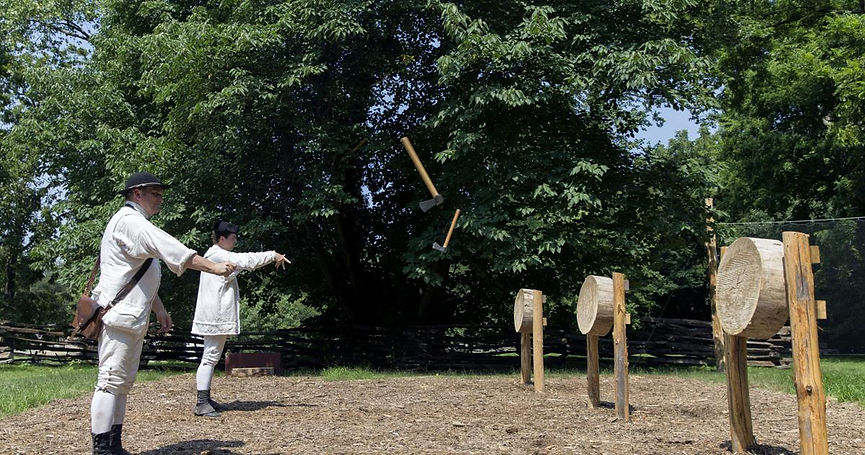
The Colonial Williamsburg axe-throwing range offers a unique experience where visitors can learn about the history of axe throwing during the American Revolution.
Participants receive a safety briefing and learn about the proper technique for throwing axes,
which were commonly used for chores and entertainment rather than combat.
The axe-throwing range operates daily from 10 a.m. to 3 p.m.
Continue to walk west on Nicholson Street to the Carpenters Yard.

Carpentry was one of the most common trades in Williamsburg. From one end of town to another, houses, shops, sheds, dairies, smokehouses, kitchens, and storehouses exhibit the handiwork of carpenters. Discover how the experts use hand tools to transform trees into lumber, cut and raise heavy timber building frames, and enclose new structures with siding and roofing.
Backtrack slightly from the Carpenter, west on Nicholson Street. Turn south on Botetcourt Street, then east on Duke of Gloucester Street. Visit the Milliner & Mantua Maker, the Silversmith, the Wigmaker (across the street), then cross back across Duke of Gloucester Street to the Apothecary.
MILLINER & MANTUA MAKER
These are the (primarily) women who made clothing, accessories and updated older fashions into the more modern 18th century fashions.
Most people knew how to sew in the 18th century. As a basic life skill, sewing was taught to boys and girls from all levels of society as part of their practical education. But knowing how to sew didn’t mean that everyone knew how to make clothing. Cutting out the shapes for garments and fitting them to a unique body was something an individual had to be trained to do through a formal apprenticeship.
Only professionals had the full range and depth of skill necessary to produce clothing. While sewing did happen at home, it was the kind of sewing that mended and maintained a wardrobe, rather than the sewing that manufactured item from start to finish.
So how much of a wardrobe did an 18th century woman have? That's actually kind of a difficult question to answer, but we have a list made out by Martha Jefferson, wife of Thomas Jefferson:
"16 gowns (18 if you count the 2 “to be made up”), 9 petticoats, 18 aprons, and 20 shifts."
I'm not sure what motivated Martha to make this list. "“Thomas, I only have 18 gowns! I simply must go shopping at the Milliner's or I'll have nothing to wear!” ???
THE SILVERSMITH
THE WIGMAKER
Routinely wearing a wig may seem strange to us, especially for men, but it communicated the wearer's elegance, his station in society, and even his occupation. With the skill of a barber and hairdresser combined, wigmakers fashioned "perukes" of quality and distinction.
THE APOTHECARY
What was it like to be sick or injured in colonial times? Meet the apothecaries and learn how medicine, wellness, and surgical practices of the 18th century compare to today.
Continue to the end of the Dule of Gloucester Street where you'll find the Capitol Building.
Duke of Gloucester Street dead ends at the Capitol Building so go south on Blair Street. Go east on Francis Street to the Gunsmith shop.
GUNSMITH
Of course since we were fighting the American Revolution and people hunted for game, there had to be a resident gunsmith to make the guns. They were also needed for hunting to provide food and game for the colonists.
Go north on Waller Street to the Presbyterian Meeting House.
Evening: Have dinner at Christiana Campbell's Tavern: 101 South Waller Street.
This is my favorite Williamsburg Tavern. It was George Washington's and Thomas Jefferson's favorite hang out as well, Washington having eaten over 100 meals there.
The woman above does a fantastic job of portraying Christiana Campbell. She was very entertaining.


Christiana's is known for its seafood so enjoy the historically inspired, locally acquired menu of shrimp, scallops, and fish, and of course their world-renowned crab cakes and spoon bread.
The crab cakes and fried chicken are my personal favorites. The food is great as was the service. Again, a bit on the pricier side but not quite as expensive as the Terrace Room at Williamsburg Inn and you'll get more than enough to eat as the portions are large. Christiana's is only open from 4 p.m. to 8 p.m. Tuesday through Saturday for dinner. Reservations are a must.
Please note: Campbell’s Tavern is not ADA-accessible and Cellar experience is exclusively walk-up only. Seating is limited, so be sure to arrive early to secure your place.
After dinner return to your accommodations and relax.
Day 3
Morning: Have breakfast at Traditions: 310 South England Street, Williamsburg.
Join Traditions daily from 7 am to 11 am for a carefully curated breakfast menu that blends traditional American cuisine with contemporary Southern influences.
Each dish is crafted to surprise and satisfy your palate, offering a perfect start to your day.
They offer a different menu every day of the week.
Family friendly. $$
Reservations are recommended.

Start your day of touring Williamsburg at the Powell House, just past Christiana Campbell's Tavern.
POWELL HOUSE (Great for Hands-On Fun for kids!)
This 18th-century home offers interactive activities like gardening, cooking, and colonial games.
Kids can try simple chores from the past, like fetching water and washing laundry.

From Powell House walk west on Nicholson Street to the Public Gaol. (Pronounced "jail")
This was my favorite building in Williamsburg, having worked as a Corrections Officer. If inmates today think they have it rough, they should spend a few days shackled in the gaol.
Yes, if you were facing execution they put your coffin right in your cell with you and at least one of the cells had a view of the gallows where the prisoner would be hung. They didn't mess around in those days. There were 10 days before trial and execution. No plea bargains or endless appeals. 10 days start to finish, over and done with. SCHWIIIIIIING! Next prisoner please!
And if that wasn't enough to give you a sufficient attitude adjustment, they'd publicly humiliate you by throwing you in the stocks in front of the entire town or whip you at the whipping post.

Travel west down Nicholson Street to Colonial Street. Go south on Colonial Street across Duke of Gloucester Street and walk to the Public Armoury, then the Blacksmith, and the Tin shop.
PUBLIC ARMOURY
THE BLACKSMITH
Blacksmiths begin their day by lighting fires in the forges outfitted with bellows and a hood to carry away smoke. Once the fires are roaring, they heat bars of iron and use sledges weighing up to 12 pounds to hammer the heated bars into various shapes. The Blacksmiths work with other trades to make tools and other materials, such as nails for the Carpenters.
TINSMITH
Head back toward the Visitor Center to the military encampment at 101A Visitor Center Drive, Williamsburg.

For the Kids: The Children's Military Drill at Colonial Williamsburg is a unique and engaging activity for young visitors. During this event, children can "enlist" in the colonial army and learn basic marching drills. Led by costumed interpreters, this activity is both educational and fun, allowing children to participate in a historical and interactive way. The event takes place on Tuesdays through Thursdays, June through August and is free and open to the public. It is a great opportunity for families to witness the military maneuvers and musket firing on Market Square Green, all to the lively tunes of the Colonial Williamsburg Fifes & Drums. View the schedule for this event here
Visit the military encampment. Soldiers in the Virginia State Garrison Regiment enlisted for three years, and garrison duty was year-round. This is an active military camp where you'll be encouraged to enlist and be given your first instruction in the manual of arms by your drill sergeant. Take part in drill practice and watch a musket being fired.
From the military encampment head south on Nassau Street to the Public Hospital of 1773 and the Museums.
Afternoon: Have lunch at the Museum Cafe: 326 Francis St W.
Their thoughtfully curated menu offers something for everyone—from hearty soups and fresh salads to satisfying sandwiches and classic entrees.
Start with a light, crisp salad or a flavorful wrap, perfect for a quick and satisfying bite. For those seeking something heartier, the mains range from classic comfort foods to inventive seasonal dishes that celebrate the best of the region's flavors.
Pair your meal with a refreshing glass of tavern beer or wine, or keep it light with one of their signature dishes. Families will find kid-friendly options.
Try the Ham & Cheddar Melt!
$$
Tour the museums after breakfast, then move on to visit the Public Hospital of 1773.

Museum Cafe Photo credit: Colonial Williamsburg
The Public Hospital of 1773 was the first mental institution in the U.S.

Merchants Square Ticket Office
On your way out, stop at the Merchants Square Ticket Office. Purchase tickets to Merchants Square for tomorrow's itinerary.
Evening: Have dinner at Sweet Tea & Barley: 310 South England Street, Williamsburg.

The chefs take great pride in crafting dishes that not only showcase the time -honored recipes of the South but also
incorporate modern techniques and fresh, seasonal ingredients.
They offer an all day menu, a dinner specials menu and a kids menu. Enjoy a diverse menu, from crisp salads to indulgent pub bites and hearty sandwiches
Sweet Tea & Barley comes alive every Friday and Saturday evening with live music performances.
Hours:
Sunday
12:00pm - 10:00pm
Monday - Wednesday
4:00pm - 10:00pm
Thursday
12:00pm-10:00pm
Friday - Saturday
12:00pm - 11:00pm
After dinner consider taking one of Williamsburg's Ghost Tours. Even if you don't believe in ghosts, these tours are fun.

Photo credit: Colonial Williamsburg
There are multiple different ghost tours you can take at Williamsburg. Book early because they fill up fast!
The Night Watchman’s Ghost Tour and Colonial Ghosts Tour are excellent family-friendly options for kids in Colonial Williamsburg, offering engaging storytelling and historical insights. They won't scare the kids.
With all its important history, it is not surprising that Williamsburg has had its share of ghost sightings.
Whether people believe in ghosts or not, ghost tours are a fun way of touring and getting to know a city and one of the entertaining and educational things to do in Williamsburg.
Colonial Ghosts has been ranked among America's top ten ghost tours. A guide leads the tour on a nightly walk through the city’s historical sectors, with a special tour including the College of William and Mary.
The Original Ghost Tour is Virginia’s oldest ghost tour. Visitors can take an hour and a half of walking tour through Colonial Williamsburg and learn many of its secrets.
The tour begins at 8:00 p.m. and is $19.00 per person. Visitors can include a pub crawl to meet both ghosts and great pubs. The cost for the pub crawl is $46.00.
The Original Ghost Tour begins at 345 W Duke of Gloucester St.
The Dead Of Night Ghost Tour is a don't miss. Renowned for its authenticity and research, this tour is often regarded as one of the best ghost tours in the country. It'll leave you looking over your shoulder when it's done.
Guided by lantern light, you’ll wander through ancient streets, uncovering tales of ghosts and legends that linger in the shadows. Each story is a blend of historical facts and spine-tingling lore, making the past come alive in a chillingly unique way.
Your expert guides will use paranormal equipment to summon the ghostly spirits!!!
This is the most popular ghost tour at Williamsburg and sells out FAST so you need to make your reservations early.
Ages 12-99, max of 25 per group. Price of tour is currently $30 per person. Tours last 1 hour and 45 minutes and starts after dark, usually 9 to 10 p.m. Check the link above for more details.
The tour is completely wheelchair accessible.
Colonial Williamsburg best ghost tour for kids
For families looking for a ghost tour in Colonial Williamsburg that is suitable for kids, the Night Watchman’s Ghost Tour is highly recommended. This tour is designed to be spooky but appropriate for all ages, making it a great option for families visiting with children. The tour features compelling storytelling, historic backdrops, and a sense of mystery that keeps guests engaged. It is a pet-friendly tour and offers a unique experience that blends colonial history with ghost stories that will not scare children.
Day 4
Morning: Have breakfast at Colonial Pancake House
301 Page St, Williamsburg, VA
One of the highest-rated pancake houses in Williamsburg. They have a nice menu selection and you’ll find some rare items, such as scrapple.
What’s scrapple you ask? It’s a mixture of pork trimmings and scraps combined with spices, cornmeal, and wheat flour which is then fried.
Their home fries, served more like scalloped potatoes, are a cult favorite.
Get your tickets out that you purchased yesterday and visit Williamsburg Merchant's Square, adjoining Colonial Williamsburg.

Merchant's Square is an odd mix of modern and colonial that somehow all works together. You can still even see musket holes in the sides of some of the buildings.
It's great to hit the Square up in the day time but it's also a place for nightlife with live entertainment, restaurants, etc. It has the same colonial flavor as Colonial Williamsburg does with its cobblestone streets and architecture.
There are so many cool shops and stores here that it's easy to spend the day just browsing the shops alone.

I absolutely love the Cheese Shop with cheeses from all over the world - especially the Champagne Cheese and Herb Crusted Goat's Cheese.
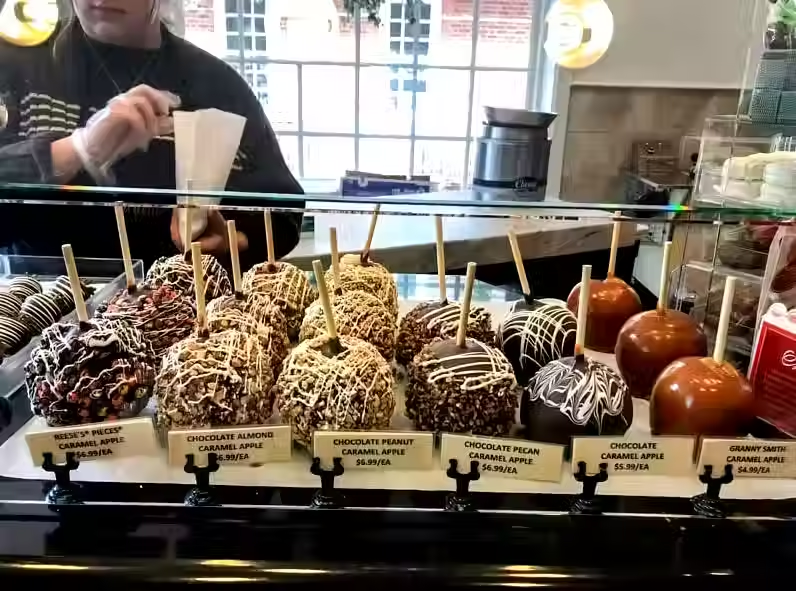
Whythe Candy Shop is another must stop. Williamsburg’s beloved candy store for 50+ years. Offering freshly made fudge, hand-dipped chocolates, caramel apples and the region’s largest selection of candy.
Check out the Peanut Shop as well. Locally grown and roasted in the heart of peanut farmland south of the James River. A favorite with locals and visitors for over 50 years, the
Peanut Shop of Williamsburg also features regional specialty foods, confections and gifts for entertaining.
Money $aving Tip: On Wednesdays, seniors get 15% off at the Peanut Shop of Williamsburg.

There's even a toy store for kids featuring colonial toys.
Money $aving Tip: Currently save over 60% off the regular price on our exclusive plush costumed dolls. These dolls were developed in partnership with Historic Area interpreters and make great gifts for kids. $15 each.
Offer includes only the styles shown.
These seemed to be a popular doll as I saw a few little girls carrying one around and Ashley got one as a souvenir or her Williamsburg trip.
Merchants Square is also home to the Kimball Theater.
The Kimball Theatre has been owned and operated by The Colonial Williamsburg Foundation for 90 years. Originally called the Williamsburg Theatre, John D. Rockefeller, Jr.
opened it in 1933 as an official Radio-Keith-Orpheum (RKO) theatre along with Radio City Music Hall and The Roxy Theatre in New York City. Today, the Kimball is a cornerstone of Williamsburg's performing arts
community, home to stage productions, musical performances, film screenings, speakers, and more.
If there's an event being held at the Kimball Theater during your visit it would be worth your time to see it.
Afternoon: Have lunch at your choice of one of the many restaurants in Market Square. DoG Street Pub had excellent hand-tossed, stone-baked pizzas if that interests you. They have a nice assortment of other menu items as well. $$
After lunch continue to explore Market Square. It had a nightlife of its own so it's worth your while to stick around for the nightly live entertainment.
Evening: Have dinner at Blue Talon Bistro: 420 Prince George Street, Williamsburg.

Photo credit: Blue Talon Bistro
Celebrated chef David Everett offers relaxed “bistro” dining serving up comfort food with flair. The attention to the consistency and quality of menu items, wine list, and cocktails combines with the casual atmosphere to transform your experience into one of relaxation and fun.
Sunday, Monday, & Thursday
Breakfast 8:00AM - 10:30AM
All-Day Menu 11:30 - 3:00 / 4:00 - 8:00
Sunday Brunch 11:30AM - 3:00PM
Friday & Saturday
Breakfast 8:00AM - 10:30AM
All-Day Menu 11:30 - 3:00 / 4:00 - 9:00
Closed Tuesday & Wednesday
After dinner enjoy the nightlife Merchants Square has to offer before returning to your accommodations.
Day 5
Morning: Have breakfast at the restaurant of your choice.
This is your last day in Williamsburg so I'm going to leave your itinerary up to you and just give you some suggestions as to things you may not have seen or done yet.
TAKE A CARRIAGE RIDE

What To Expect and How To Plan Your Carriage Ride
By Fife & Drum Inn
With their motto “see our city differently,” Colonial Williamsburg’s 15-30 minute carriage rides – which they’ve been doing daily for over 75 years now – offer a way to see the historic area from the same vantage point as you would have hundreds of years ago. Your ride will have an interpreter lead the horses and guide you through the historical sites along Duke of Gloucester Street and around the Palace Green as you approach the historic Governor’s Palace, a symbol of British dominance that spurred the Revolution.
Tickets can be purchased in person at the Lumber House Ticket Office. The ticket office opens daily at 8:45 am. You can also purchase a Colonial Williamsburg admission ticket, which provides access to all the trade shops, art museums, and various tours and performances. Helpful hint: an adult annual pass is only $25 more than a daily adult pass, and a child annual pass is just $13 more than a daily child pass, so if you plan to visit Colonial Williamsburg more than one day, it’s a great deal.
Their historically accurate carriages are wood-carved, beautiful to look at, smooth to ride, and can accommodate whatever size group you have. The yellow-hued Romantic Wythe seats two and is perfect for a romantic ride with your special someone. If you have a bigger group, the Madison, Red, and Spraggins sociable carriages have two sets of seats facing each other and can fit four adults (or up to 6 people if you have kids in your group). Lastly, the stage wagon is a carriage with a covering overhead, providing shade during the heat of summer and with forward-facing row seats.
The Benjamin Lewis Spraggins, Sr. sociable carriage tells a unique story as it honors the African-American carriage couriers who were both incredible horsemen and expert tour guides throughout the many chapters of Williamsburg’s past. If you ride that carriage, check out the “BLS” monogram on the wagon's side, an intricate and artistic homage to these men who played an essential role in Williamsburg's daily rhythm of life.
Although Colonial Williamsburg aims to offer carriage rides every day of the year, sometimes the weather can get in the way, especially on the hottest days of midsummer or the coldest days of winter. With the summer days ahead, their team of animal caretakers pays close attention to the heat index, which considers both temperature and humidity. When the combined heat index gets near 100 degrees, the horses take a break between every other ride, and when it gets above 105 degrees, carriage rides shut down for the day. When you visit the Lumber House, their helpful staff will update you on whether the heat will affect that day’s carriage schedule.
For the Kids: After your carriage ride, plan to do the stables behind-the-scenes tour (offered daily at 1 pm with an extra $8 charge for the one-hour tour), where you’ll get a fascinating look at all that goes into caring for the stable of horses and oxen and the daily upkeep of the wooden carriages. This tour is $8 in addition to the daily historic area ticket. The Coach and Livestock team at Colonial Williamsburg is esteemed for preserving “rare breeds” of horses and cattle, Leicester longwool sheep, and three types of chickens. On your carriage ride, you’ll be up close with one of several majestic animals: the Cleveland Bay horse, England’s oldest breed and prized for its gorgeous reddish tint and easy temperament; the American Cream Draft horse, which has a distinctive white coloring, weighs up to 1,800 pounds and is one of the rarest horse breeds in the country; Red Devon Cows, impressive for their quality of milk and oxen, known for their strength in wagon-pulling.
If you plan to visit over the upcoming July 4th holiday, take advantage of Colonial Williamsburg’s free admission tickets on July 4th. Take a carriage ride, listen to the live reading of the Declaration of Independence (appropriate on our country’s birthday), and stick around for the spectacular fireworks show over the Palace Green at 9:30 pm.
WATCH A MUSKET FIRING
Visit the military encampment. Soldiers in the Virginia State Garrison Regiment enlisted for three years, and garrison duty was year-round. This is an active military camp where you'll be encouraged to enlist and be given your first instruction in the manual of arms by your drill sergeant. Take part in drill practice and watch a musket being fired.
But you don't have to just watch a musket being fired. You can fire one yourself!

Photo credit: Colonial Williamsburg
You don't have to be a gun enthusiast for this one...It was fun just firing a musket for the experience.
Fire live rounds at a target from two different reproduction 18th-century flintlock firearms commonly used during the Revolutionary War, and learn about the history of the weapons.
Book your time: 9:30 am; 11:00 am: 1:30 pm; 3:00 pm Tuesday, Friday, Saturday and Sunday (with some exceptions see their calendar) Closed Monday, Wednesday and Thursday)
TOUR THE GARDENS & ARBORETUM

More than 30 carefully maintained gardens adorn Williamsburg.
From flowering backyard pleasure gardens to the grand Governor’s Palace Gardens and Grounds, these gardens can offer insight into how the colonists lived and worked as a community.
The Colonial Williamsburg Arboretum is a Level 2 Certified Arboretum comprised of 18th-century tree and woody shrub varieties as well as modern cultivars on our Hotel and Museum properties. The collection features 25 period species of oak trees and more than 30 historic gardens.
Guided tours are offered. Check this calendar for dates and times.
TAKE A FOODIE TOUR
Indulge yourself with the Williamsburg’s Food Tours like the Modern Gastronomy Walk or the Historic Taverns Taste Tour. They're a blend of colonial history and modern - the Historic Taverns Taste Tour being the colonial era fare.
VISIT THE PLAY HOUSE STAGE
Visit the Play House Stage and see a performance: 208 Palace Green Street, Williamsburg.

The American colonies' first purpose-built theater opened on this site before 1720. Today, you can take in a lively performance by the Play House Players on an open-air stage.
See the calendar of events for a schedule of musical and theatrical entertainment.
Admission requires a separate admission ticket. Shows run during the course of a day and in the evening. Wheelchair accessible.
We saw To Hang A Pirate which was very well done and well worth the $19 per ticket.
In late 1718, a Royal Navy expedition was dispatched from Virginia. The pirate Blackbeard was killed off the coast of North Carolina, and 15 members of his crew were captured and brought to the Public Gaol in Williamsburg. They were tried for piracy at the Capitol by Virginia Governor Alexander Spotswood in early 1719. This show is a recreation of the actual trial of Israel Hands, a member of Blackbeard's crew.
Photo credit: Play House Stage
WATCH THE FIFE & DRUM CORPS
At times while walking through Williamsburg you'll see their various Fife & Drum Corps come parading down the street. One of these Corps is comprised entirely of kids!
You'll usually see them parading in late afternoon.
Take a few minutes to stop and watch them. They've performed all over the world!
TRY SOME COLONIAL FOODS YOU HAVEN'T TRIED YET
America will celebrate its 250th birthday on July 4, 2026. This
milestone marks the 250th anniversary of the signing of the
Declaration of Independence. What better way to celebrate than to throw a Colonial Party?
Decorations
You can use anything patriotic and/or Early American: banners, bunting, balloons, streamers, metallic fringe curtains, wall sconces, lanterns...
My furniture lends itself to this so I had an easy time of decorating.


For the most part I used just what I had on hand.

I used my antique sideboard to put food on.
My husband had a set of blue and white china that I used for the dinner I served.

My living room furniture lends itself to a colonial party so decorating was simple for me.
Rather than a photo backdrop I hung a colonial painting I'd done in college. I made a colonist cardboard standup behind the furniture.


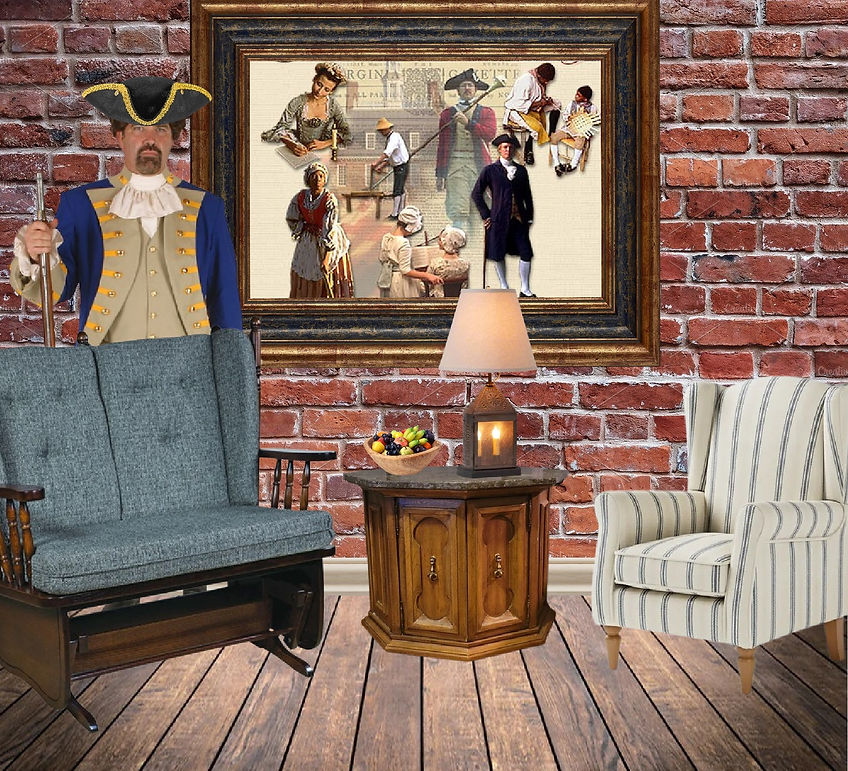
For another wall, I had to disguise my modern sofa so threw a colonial-style quilt over it. I bought an inexpensive Halloween costume to dress my mannequin in. I hung bunting as window valances and placed a candelabra I have next to the sofa. The pewter coffee set was my husband's retirement gift from his employer.

Food/Menu
I did a sit down dinner using recipes from Colonial Williamsburg kitchens.


Fried Chicken
Salad with dressing
Sweet Potato Buns
Beef Steaks
Mashed Potatoes & Gravy
Ragoo French Beans
But nothing says you have to serve a sit down dinner! Do a colonial hors d' oeuvres type buffet that guests can help themselves to and snack from, using colonial recipes!


Fried Crab Cakes
Ratafia Cakes
Potato Balls
Chelsea Buns
Spinach Toasts
Salmagundy
Cracknels
Gingerbread Cakes
Tourte de Chocolate
There's no law that says you even have to serve colonial food! If you want to do a 4th of July BBQ then do a 4th of July BBQ!
Games & Activities
In colonial times, the time period between the early 1600s and the late 1700s, there were no electronic video games or huge stores full of manufactured board games and toys. Instead, children relied on their imaginations and simple materials found around their homes to come up with colonial toys and games. In colonial America, games for children were fun, innovative and competitive.
If you want to keep things really authentic, play the games the colonists played.
FOR KIDS

HOOP PLAY
Homestead Toys says that colonial kids played hoops by racing metal or wooden hoops along the ground with their hands or sticks. The hoops were often salvaged from old barrels. The object of the game was to keep the hoop rolling as long as possible and get to the finish line first.

HOPSCOTCH
Hopscotch is a wonderful hopping game that can be played on a bare patch of ground or on a floor indoors. There are hundreds of variations of the diagram that can be drawn. Use your favorite version to have children play.
Use chalk to draw a hopscotch pattern on the ground or use masking tape on a floor. Create a diagram with 8–10 sections and number them. Each player has a marker such as a stone, beanbag, bottlecap, shell, button, etc.
The first player stands behind the starting line to toss her or his marker in square 1. Hop over square 1 to square 2 and then continue hopping to square 8 (or 10), turn around, and hop back again. Pause in square 2 to pick up the marker, hop in square 1, and out. Then continue by tossing the stone in square 2. All hopping is done on one foot unless the hopscotch design is such that two squares are side-by-side.
Then two feet can be placed down with one in each square. A player must always hop over any square where a marker has been placed.
A player is out if the marker fails to land in the proper square, the hopper steps on a line, the hopper loses balance when bending over to pick up the marker and puts a second hand or foot down, the hopper goes into a square where a marker is, or if a player puts two feet down in a single box. The player puts the marker in the square where he or she will resume playing on the next turn, and the next player begins.
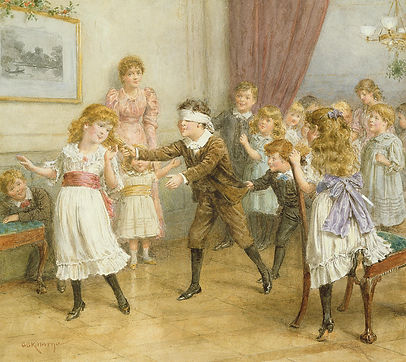
BLIND MAN'S BUFF
Called “blindman’s buff,” this game was popular with adults as well as children in the 1700s. In earlier times, the players not only spun the blindfolded person around, but shoved or buffeted him or her, which is how the name “buff” started. The colonists played the game according to the rules used here. Any number can play; the more the better.
You'll need one blindfold for this game.
-
One player ties a blindfold securely around the person who is “it.” The other players form a circle around him/her.
2. One or two players step forward. They spin the blindfolded player around two or three times, then rejoin the circle.
3.The players join hands and walk in a circle around the blindfolded player. The player who is “it” claps three times and the circle stops moving.
4.“It” points at one player who must step into the circle. The blindfolded player has one chance to guess who the person is. If the guess is right, that person takes the blindfold. If the guess is wrong (and it usually is), the blindfolded player tries to catch the player by touching him on the head, clothing or feet.
5.The blindfolded player then has one more chance to guess who the player is. If the guess is right, they change places and the player become “it.” If the guess is wrong, the player rejoins the circle, the blindfolded player is spun around again, and the game continues.

JACKS or JACKSTONES
The game the colonists called jackstones is known today as jacks. You can buy a set, which includes six 6-pointed metal jacks. Set of 12 at Walmart
-
Two or more people can play, indoors or out.
-
To start: a player tosses the ball in the air, scatters the jacks, and catches the ball on one bounce. The player wants the jacks to land pretty close together, but not so close that they’re hard to pick up one at a time. Even if he doesn’t like the way they landed, he must play the jacks as they lie.
-
During play, the player must pick up the jacks and catch the ball on one bounce with the same hand.
4. When picking up jacks, the player can touch only the ones he is picking up. If he moves or touches others, his turn is over.
5. On any play, each player has only one try. If he makes a mistake, it’s the next player’s turn.
6. If a player makes a mistake and loses his turn, on the next turn he goes back to the beginning of the play in which he made the mistake.

MARBLES
Colonial children enjoyed playing marbles. Claude Moore Colonial Farm, a living history farm, states on their website that colonial marbles were made baked or glazed clay, stones, glass or nut shells, quite different today's more valuable marbles. To play marbles, players rolled or "shot" into another player's marbles in order to knock them out of a designated area. The player who knocked the marbles out of the area got to keep those marbles. Whoever had the most marbles at the end of the game won.

JACKSTRAWS OR PICK UP STICKS
Jackstraws was the precursor to the modern game of pick up sticks. Materials needed to play were pieces of straw (broom straws worked well) or sticks approximately six inches long. The sticks were dropped to create a pile and players had to remove the sticks one by one without moving any other sticks in the pile. If another stick was disturbed, that player's turn was over. Play continued until all sticks were removed. The person who had collected the most sticks at the end of the game was the winner.
MAKE A BUZZSAW
Games for Kids & Adults
GAME OF GRACES
The game of graces was another form of hoop play. In this game, players threw small hoops decked out in ribbons to one another, catching them on wands. This game was almost always played by girls since it was meant to make young ladies more graceful. To play, each player held two wands (or rods). Using both rods, one player positioned a hoop onto the rods and, using a scissor-like motion, sent the hoop into the air towards the other player. The other player caught the hoop with her two rods. The player who caught the hoop ten times won the game.
QUOITS

Quoits was basically a ring toss game and similar to horseshoes. Players had to toss rings made of metal, rope, leather or even tree branches, a set distance over a stake in the ground called a hob. Each player threw two rings per turn. Points were earned based on how the ring landed on the hob. The player with the most points won the game. Quoit sets could be large for outdoor play or small for tabletop play.
Quoits can be played with two people, four people, or, if you want to practice, individually. Below is a list of all of the standard rules.
Starting A Game:
-
The quoit boards are placed 18 feet on center (from hub to hub).
-
Who throws the first pitch of the first game. After the first game, the loser of the
prior game makes the first pitch to start the game.
3. Pitching turns alternate with each quoit.
4. The pitcher’s forward foot may not extend beyond the hub of his “home” board.
Determining The Score:
-
The first person or team to reach a score of 21 wins the game.
-
Every “ringer” (meaning the quoit landed on the hub) is worth 3 points (see P1 below).
-
If a player should make a ringer and have his second quoit closer to the hub than his opponent, he receives 4 points (Three points for the ringer and 1 point for the quoit closest to the hub).
-
Each ringer pitched counts as 3 points (see P1 below), except when the same player pitches two ringers, one directly on top of the other. This player is then awarded 3 additional points, for a total of 6 points (see P3 below).When the first player pitches a ringer which is topped by an opponent, it is the opponent only who receives 3 points (see P2 below). When the first player pitches a ringer which is topped by an opponent and then topped by the first player again, the last ringer made by the first player counts as 3 points for the first player. As a premium, when four ringers are made, the player pitching the last ringer wins the game.
-
Every “leaner” (meaning the quoit is leaning against the hub but not a ringer) is worth 1 point (see P4 below).
-
If there are no ringers and leaners, the person who throws the closest quoit gets one point. If the same person’s second quoit is the next closest he/she gets two points (see P5 below).
-
The rings on the board are used to determine the closest quoit. If you cannot determine the closest quoit from the front side (closest side of the quoit to the hub) you can usually determine it by comparing the backside (the side of the quoits furthest from the hub) to the outer rings (see P6 below).
-
If a quoit is touching the ground, or has touched the ground, it is a “dead quoit“. Remove it from the board before the next pitch. If you don’t remove it any quoits that touch a dead quoit are also dead (see P7 below).
-
A quoit can be hanging off the side of the board. As long as it has not touched the ground the quoit is still good (see P8 below). This is called the daylight rulebecause you can see “daylight” through the quoit since it is hanging off of the board. This rule is sometimes disputed, so decide if you want to play “Daylight Counts” before you start playing against your opponent.
-
Interference due to a wandering dog or small child (which sometimes happens) is grounds for a “re-throw” (a.k.a. do-over) if the quoit is deflected during release or in mid-air.
NINE PINS

Ninepins was brought to the colonies by Dutch settlers. The game is very similar to modern bowling. Ninepins could be played on a tabletop with small pins or on a lawn with larger ones. The only materials needed to play were nine wooden pins and a ball. These were set up in a diamond shape. Each player rolled the ball ten times to see how many pins he could knock down. The player who knocked down the most pins won the game.
BATTLEDORES

Battledores was an early form of badminton. Players would try to hit a shuttlecock with two wooden paddles, often while reciting rhymes. The paddles were often made of hornbooks, which were early reading tools made into the shape of a paddle. To play the game, two people hit the shuttlecock back and forth with their paddles as many times as possible without letting it fall to the ground.

.png)