
March 25, 2026
Turn sound to video on/off here
Sitting seventy miles west of Key West is the last group of islands in the Florida Keys. This is the location of
Dry Tortugas National Park, one of the least visited National Parks. In 2023, only 84,000 people visited this park. That averages out to about 230 people per day. I'm assuming that's because the Dry Tortugas are so remote you can only get to them via boat/ferry or seaplane.
And with a limited number seats on the ferry and seaplanes, there is a limit to the number of people who make it Dry Tortugas National Park. Currently the ferry is booked out A YEAR IN ADVANCE. So this isn't a 'plan it on the spur of the moment' trip.

You can only get to the Dry Tortugas via boat or seaplane
Dry Tortugas National Park is made up of seven islands: Garden Key, Loggerhead Key, Bush Key, Long Key, Hospital Key, Middle Key and East Key. That might sound like a lot, but 99% of this park is underwater.
Garden Key is the only "inhabited" of the islands, so to speak. This is where the ferry and seaplanes come in and where Fort Jefferson is located.
During certain times of the year (mainly the winter months), Bush Key is also open to visitors. Loggerhead Key sits about 3 miles from Garden Key, so you will need a boat to get there, and the remainder of the islands are closed all year since they are home to bird nesting sites.

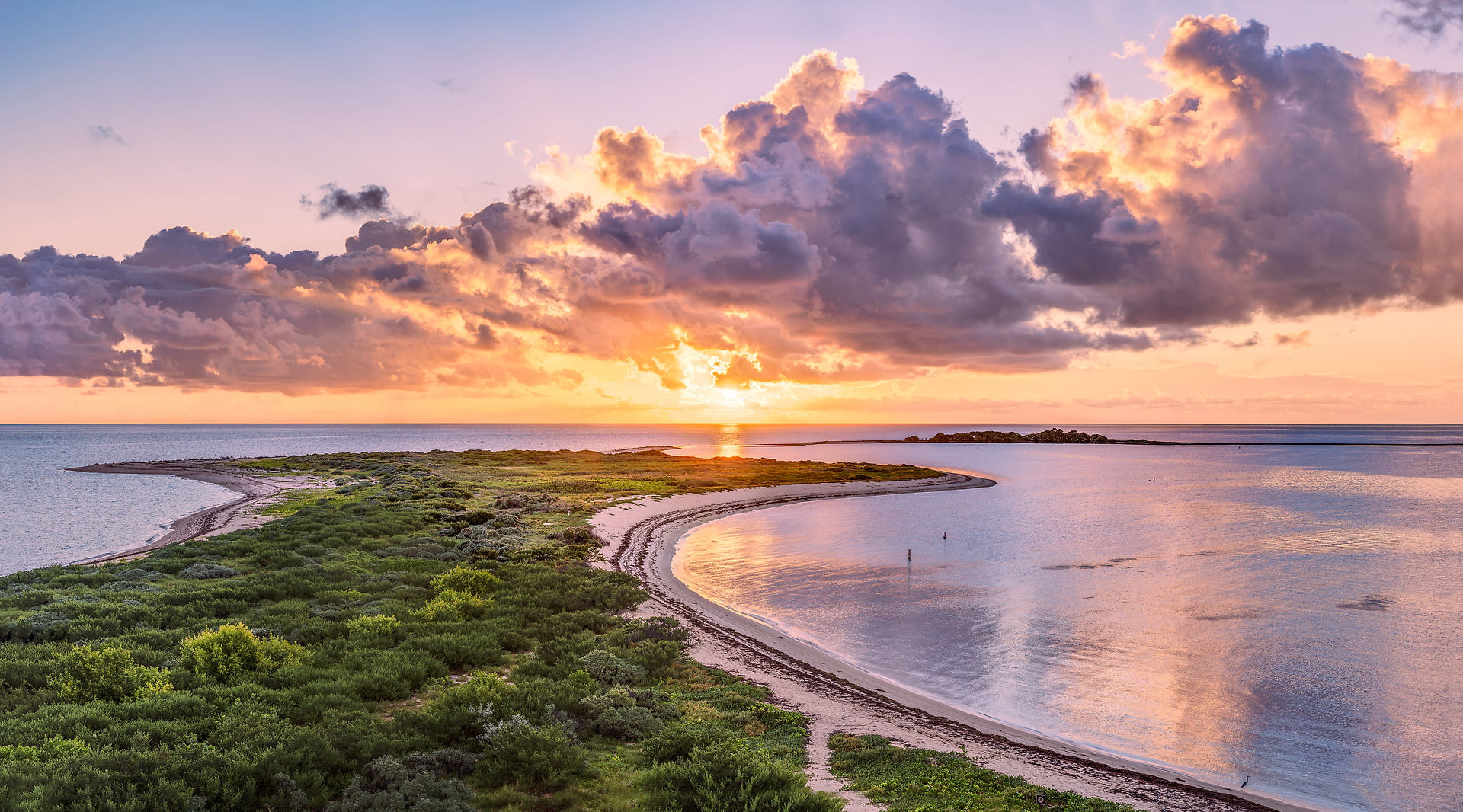
Bush Key at the end of Garden Key / Photo credit: EarthTrekkers
Our trip to Dry Tortugas was just part of a larger trip to Key West in the Florida Keys but since this is about National Parks, I'm limiting the post to the Dry Tortugas portion of that trip. Actually, I didn't even know we'd be going to Dry Tortugas. That trip was among a few surprises Jay had waiting for me down in Key West.

.png)
-
There is NO FOOD OR WATER available on the island so bring your own.
-
There is little shade on the island so go prepared for that with adequate sun protection.
-
Cell service is extremely limited or nonexistent.
-
Restrooms are basic. They exist, but this is very much a remote, no-frills national park experience. If the ferry is docked, you will use the restroom there (even if you arrived by plane). If not, the composting toilets near the campground will be unlocked.
-
You cannot take seashells (or anything but purchased souvenirs) from this National Park.
-
The best time to visit Dry Tortugas National Park is November through April.
-
If you're planning on snorkeling or swimming there are no lifeguards and water/weather conditions can change. Hurricane season begins (June through November); storms can pop up quickly.

If you're flying into Florida you first need to get to Key West.
If you fly into Miami International Airport and rent a car, you’ll have a 160-mile drive that will take three hours without stopping.
Another option is to fly into Southwest Florida International Airport in Fort Myers and take the Key West Express boat to Key West for access to Dry Tortugas. You’ll spend $185 for each adult to get a roundtrip ride.
Money $aving Tip: Book that Key West Express at least eight days in advance and travel Monday through Thursday to lower the price to $155.
FROM KEY WEST TO DRY TORTUGAS
The ferry that runs to the Dry Tortugas is the Yankee Freedom Ferry.

It departs daily from Key West at 8 am and returns around 5:30 pm. Travel time is approximately 2.25 hours each way, with 4 - 4.5 hours on the island.
Cost for a day trip is $220 - $235 per adult, including the National Park Entrance Fee, breakfast, lunch and snorkeling equipment.
Amenities include onboard restrooms, galley and guided tours of Fort Jefferson.
-
Pros: Most economical, allows camping gear, snorkeling, and kayaks.
(The number of kayaks the ferry can take is very limited!) -
Cons: Longer travel time, potential seasickness, more crowded experience.
Your ferry fare should be discounted if you have the America The Beautiful Pass. If you have this pass be sure to inform Yankee Freedom Ferry when you book your tickets.
We did not take the ferry but we spoke to some people that did. They reported the ferry was comfortable with plenty of room to move around, you could purchase food at their snack bar that wasn't exorbitantly overpriced,
there were three bathrooms aboard. Don't expect much in the way of meals you get. For lunch they got a brown bagged sandwich, bag of chips and a drink so you might want to pack your own food/snacks and water for later in the day. (Remember, there's no food or water on any of the islands!)
Your ferry fare will also include snorkel gear.
SEAPLANE
While I'm sure the view is far better flying in on a seaplane, costs will run between $450 and $800 to do so, depending on how long you will stay.
The flight from Key West to Dry Tortugas takes 40 to 45 minutes. Your park entrance fee is included in your flight fee.
CHARTER OR RENT A BOAT
You can charter or rent a boat as another option, but I recommend doing this if you're with a group that can split the rental cost. Most charter companies in Key West generally charge $100 per hour. Depending on what kidn of boat you want, what features you want on the boat, duration of your rental, etc. costs run between $1000 and $2000 and upwards for a half day or full day.
The Best Boat Rentals In the Florida Keys.
PERSONAL BOAT
Your last option is to use your personal boat if you have one. This is your most flexible option as you can then go between islands, pack your own gear, take a kayak if your boat is big enough. I won't say it's the least expensive option as anyone who has owned a boat can tell you, it's a hole you continually sink money into.

This was how we got to Dry Tortugas, one of Jay's surprises being he'd bought a big honkin' boat - but failed to tell me he'd bought the big honkin' boat.
Which resulted in me refusing to get on the boat, believing he was about to get himself
arrested for trespassing for making himself at home on someone else's boat. This whole exchange was witnessed by everyone at the marina so someone called the cops, who then showed up believing they had a domestic violence situation on their hands. That broohaha was only
settled when Jay showed one of the cops all of the paperwork and identification proving he owned the boat!
I wouldn't speak to him the entire 70 mile cruise to Dry Tortugas. LOL
"Don't look at ME! You caused this whole broohaha! You could've just told me you owned the boat, you moron!"
(Yeah, vacation with us! We'll keep you entertained!)
If you're taking your personal boat, you dock at Garden Key Harbor, the primary docking area for private boats. Anchoring permits are required for overnight stays. Those passengers traveling there by personal vessel must stop by Garden Key to pay the entrance fee. To find more information about bringing your own boat, click here Boating.
Personal boats dock where the orange arrow is pointing below.

You'll want to arrive at the Dry Tortugas as early as possible because mooring and landing spots for personal boats is very limited.
It’s important to know how to get a boat permit and the boating rules, so here’s some help with that.

The only accommodations on the Dry Tortugas are a handful of primitive camping sites and the Raners only allow 10 campers on the island per night. Good luck getting a spot!

Dry Tortugas primitive camping area / Photo credit: EarthTrekkers
Book your accommodations reservations in Key West.
As for us, we drive 24 hours from New York to Key West. Jay has handled the reservation end of things so I have no idea where he's parking us for the night.
We pull into this BEAUTIFUL luxury RV park, down this long 'road' at the end of which is a tiki hut. Jay doesn't stop at any office or anything to pay the rental, which I found kind of odd...but I figured he'd paid in advance online or something.


I'm looking around at this RV space trying to mentally calculate how much he must've paid for it. We're talking a TIKI HUT with a flat screen TV three times bigger than the one in my house, a full outdoor kitchen, there's a small private beach with a private dock...
Being we were both exhausted from the long drive down and not exactly firing on all cylinders, I did eventually ask him (just in case he'd spaced it out) "Did you remember to pay the rental fee?"
Our conversation went something like this:
Him: "Don't need to. I own it."

"Wait...WHAT?!! What do you mean I own it?"
Him: "I mean I own it. Bought it to retire at."
"You never told me you bought an RV spot to retire at!"
Him: "You never asked." (As if this should have been painfully obvious to me)
"Well...you're retired! So why haven't you moved down here?"
Him: "Because I met you and you screwed my plans all up! Now can we quit with the
50 questions and you help me get this thing set up?"
(Oh sure...it's all my fault for screwing up retirement plans I didn't even know he'd made! ???)
Male 'logic'...gotta love it.
You have one other option available to you if you don't want to primitive camp or can't get a camping spot on Dry Tortuga but want to stay by Dry Tortuga - the Liveaboard Boat Trip by Adventure Watersports Charters.

You can skip the hotel and choose to stay on a boat for multiple nights with more snorkeling trips, fishing spots, and dive opportunities than you’ll get anywhere else.
Also be aware of the fact that neither the ferry nor a seaplane will allow scuba equipment on them!
Adventure Watersport Charters puts you in charge of the schedule. They provide the boat, accommodations, meals, and rental equipment for whatever activity you choose. You can stay on board for up to four nights and do up to six dives or snorkeling trips per day.
As one of the only permitted charter boats in Dry Tortugas National Park, this is a wonderful option to stay in the park but still on the water.
Sleeping in your personal boat on Dry Tortugas
Jay wanted to see the Dry Tortugas at night so had arranged for us to sleep on his boat overnight at the park. You can do this but there are rules you must follow and you'll have to prearrange your overnight stay.
-
Private boats must anchor within one nautical mile of Garden Key and drop anchor only on sandy bottoms.
-
Anchoring permits are required for overnight stays within the park's boundaries.
-
Private boaters can stay overnight on their vessels while anchored in designated areas.
I could understand why Jay wanted to see the islands at night after seeing them the first time myself. The Dry Tortugas are absolutely breathtaking at night! You can get an idea of what they're like by watching the timelapse video below from the Skyglow Project:
The best time to see Dry Tortugas is after 3 pm when the ferry and its tourists leave Garden Key.

The entrance fee to Dry Tortugas is $15 or admission is free with an America The Beautiful Pass,
Your admission is valid for 7 consecutive days. Payment can be made at the self-service kiosk located inside
the dock house office at Garden Key, by cash or check only. Payment is made at that location whether you arrive by personal boat or seaplane.

PAY HERE
if you stop by the Visitor Center:
They have an interactive mural and other exhibits, a Junior Ranger Exploration
Station for kids, artifact displays and a bookstore offering souvenirs.
They also have an informational 6 minute movie showcasing marine life and the history of the Dry Tortugas.
The Center is FREE.
We'd downloaded an app so we could do a self guided tour of Fort Jefferson. It works without cell phone reception.


Fort Jefferson is the centerpiece of the park | Dry Tortugas National Park
You can attend a 20 minute talk that's an overview of Fort Jefferson. This takes place just inside the entrance in a shaded area of the courtyard around 11:00 AM. You don't have to have purchased a ferry ticket to attend. The talk is FREE.
After the 20-minute talk, you have the option to continue with a 45-minute tour. Even though we had the app we decided to tag along and were glad we did. The history of the Fort is much more interesting when you learn the challenges that went into building it - like the fact the entire fort quickly began to sink, having been built on unstable ground.
Intended for a federal installment for ships to patrol the Gulf of America, construction on Fort Jefferson began in 1846. A staggering sixteen million bricks were used in its construction, a project never quite completed. Although the fort was never completed, it was used as a prison for Civil War Union army deserters. Fort Jefferson was home to hundreds of soldiers and prisoners during the Civil War, who endured the monotony of living on a 14-acre island paired with chronic malnutrition—and most, if not all of them, would argue with the Dry Tortugas’ modern reputation as a tropical paradise.
Two hundred arches support the interior. Cisterns collected 1,500,000 gallons of rainwater. More than 400 heavy guns took aim at the sea. All three levels of the fort were armed with cannons.

Fort Jefferson's most notorious prisoner was Dr. Samuel Mudd, convicted of being an accomplice to John Wilkes Booth in the assassination of President Lincoln. Mudd had set Booth's broken leg after the assassination attempt.
Mudd worked in the carpenter's shop in Fort Jefferson. He later helped save numerous lives during the outbreaks of nearly every disease imaginable at the Fort including a Yellow Fever epidemic.
As a result, Mudd was later released.
Construction of Fort Jefferson began as
part of the United States’ coastal defense strategy following the War of 1812.
It played a key role in protecting Gulf Coast shipping.
Visitors can explore the fort via self-guided tours or guided tours offered by the docents.
The fort is open from sunrise to sunset, and the top level provides panoramic views of Garden Key, Bush Key, and surrounding waters. The moat wall and interior courtyards offer additional historical insights, while interpretive signs guide visitors through the fort’s architecture and history.
Over the years, the fort’s role diminished, and it was abandoned in the late 1800s. In 1935, the collection of islands was designated as a National Monument, with National Park status not arriving until 1992.


There are plenty of great places to snorkel on Dry Tortugas, whether you're a novice or experienced snorkeler.
Let's start with the basics. There are two beaches - South Beach and North Beach.

South Beach / Photo credit: Earth Trekkers
If you're not a strong swimmer, are inexperienced and/or somewhat uncomfortable with snorkeling yet your best bet is to stick with South Beach and the snorkeling areas around it. The waters are more shallow and generally waveless and calm, and there's no strong currents to contend with. You'll still see tropical fish and coral reefs.
Just to the west of Garden Key is a coral reef that is great for snorkeling. From South Swim Beach, swim west 50 to 100 feet towards the buoys marking the end of the safe swim area and you will come to this spot.

North Beach
Strong swimmers, experienced snorkelers and scuba divers will likely favor North Beach. The water is deeper so you'll see more marine life and reefs. However, we did experience some strong currents in this area and the water is not as calm as around South Beach.
The surrounding waters are home to tropical fish, rays, sea turtles, moray eels, barracuda and several species of sharks. while the islands serve as nesting grounds for seabirds like frigatebirds and terns. We did see some white tipped sharks during out dives.
Are there some dangerous critters you should be aware of in the water? Yup.
Beware Of These Dangerous Creatures When Exploring Dry Tortugas National Park
Fort Jefferson is surrounded by a moat and a moat wall to protect it from turbulent seas. You can walk this moat wall but not swim or snorkel in the moat itself. You can snorkel in the waters along the moat wall.

The moat and moat wall
Moat Wall Snorkel Spots
-
Along the edge of the moat wall.
-
About 75 yards in the water
-
South Wharf Ruins
-
North Wharf Ruins
A designated swimming beach is at the southwest corner beyond the moat wall.
The wharf ruins include sharp, rusted metal and coral reefs in a tight space. Explore these areas only if you are an experienced snorkeler.

Snorkeling beside the moat wall
Snorkeling at night you'll see an entirely different underwater world than you'll see in the daytime.
Don't be afraid to do a night snorkel along the moat wall!
Fish aren’t as active, and some night lovers like octopuses, squid, and lobsters are often around the wall.

Coral Reef at night | Dry Tortugas National Park
The National Park Service tells us this activity is safe enough for kids who are comfortable in the water.
If you can get to Loggerhead Key we strongly recommend that you do, you can take one of the easiest yet most exhilarating snorkeling Dry Tortugas adventures - snorkel Little Africa.
Little Africa is one of the best places for children to snorkel at Dry Tortugas as well. The water is no more than eight feet deep most of the time.
Little Africa is easy to find because it’s located right off a designated swim zone.


Little Africa

The waters around the Dry Tortugas decades ago were full of ship traffic. Lacking the modern navigation technology we have today, the waters were very tricky to navigate due to being so shallow and containing reefs. So it wasn't at all uncommon for ships of the time to sink.
Within the 100-mile radius of the national park, there are nearly 300 shipwrecks, many of which can be explored when diving or snorkeling. The water around the islands is shallow, leading to a fair number of maritime accidents. If you are looking to dive into one of these wrecks, including the Norwegian Windjammer, you’ll need to secure your technical scuba diving certification before heading out into the water.
Some of the most famous shipwrecks found in Dry Tortugas National Park include the Avanti, the Windjammer Wreck, and the San Pedro. These wrecks are popular dive sites, attracting underwater explorers from around the world. The Avanti, a 19th-century steamship, is particularly well-known for its well-preserved remains and the artifacts that lie scattered around its hull.
Tackle Texas Rock

Texas Rock
A mound resting atop a coral reef harbors an abundance of marine life. During most dives, you’ll slip into the water through schools of fish just above the coral. The mound is surrounded by sand.
Head to the north side of the reef for deep-water sea fans. Crevices hold black coral.
This is a full-day dive trip.
Diving the Shipwrecks
We dove the Tortuga Wreck.
This was the ship that was intentionally sunk on April 25, 1995, for the climax of
the movie “Fair Game”. This 165-foot offshore supply vessel was sunk to create a unique dive site
and was part of the film's
climactic scene, where the characters narrowly escape from the ship.
The ship sits in 115 feet of water with the deck at

The Tortuga
about 90 feet. The wreck is sitting upright and it's not overly challenging for an advanced recreational diver as its openings are large. Key parts of the ship, such as the wheelhouse and twin propellers, are still intact.
Water visibility was around 80 feet, providing clear views of the wreck and its surroundings.
Similar dive sites in the region are known for white tip sharks, moray eels, puffer fish, lionfish, and large schools of tropical fish. (We did see a white tip shark, some barracudas and two moray eels.) There are also a heck of a lot of nurse sharks as it looked like a breeding ground may have been nearby?
There is a strong current around the wreck so start your dive against the current.
The Norwegian Windjammer Avanti wreck:

An aerial view of The Windjammer shipwreck and an insert with a closer look at the shipwreck sections | Dry Tortugas National Park
Of all the shipwrecks in this important passageway, the wreckage nicknamed The Windjammer sits well-preserved in skeletal form –proof of the durability of iron ships. This ghost ship of sorts sank on January 22, 1907, after a brave crew of 19 tried to save her.
Here’s a great summary of the ship’s history
Everyone survived this shipwreck, and all supplies were removed. Her pieces still rest across the shallow waters and are somewhat exposed at low tide.
The wreckage is a good half mile from Loggerhead Island but sits in shallow enough water that beginning divers and regular snorkelers will get quite a show.

The Windjammer shipwreck
Another cool diving spot to check out is Pulaski Shoals. The Shoals lie at the eastern edge of the park is found and marked by a light tower. It's great for snorkeling. You’ll be snorkeling at one of the most treacherous spots for shipwrecks.
More experienced divers can head 80 feet away from the shallows and see a dramatic drop in the reef. You’ll be among the most wild creatures of the open sea, including several varieties of sharks and massive grouper.


The best way to see the other islands in Dry Tortugas is by kayak.
Kayaking in Dry Tortugas offers a unique adventure through crystal-clear waters and coral reefs on the other remote islands, but requires careful planning, proper equipment, and awareness of open-water conditions.
For the most part, only campers are allowed to bring kayaks on the ferry. You can rent a kayak in Key West or bring your own.
Once you’re there, you can take easy paddle trips around Garden Key, Bush Key, and Long Key. However, you must stay 100 yards offshore of the latter two.
More experienced paddlers choose to explore the three-mile paddle of open ocean to Loggerhead Key. Beginners should not attempt this.
Once you arrive at Loggerhead Key, you get the bulk of the largest island in Dry Tortugas nearly to yourself.


A stretch of sand usually connects Garden Key, home of Fort Jefferson, and Bush Key. All it takes is one big storm or enough erosion to move that land bridge underwater. When that happens, you can still access Bush Key outside of the nesting season, but you’ll need to swim or kayak to get there. But you never know if that bridge will exist until you get to Bush Key.
The walk around Bush Key is a natural zoo of birds, sharks, and sea turtles, all in less than a mile and a half.

Anyone who loves wildlife or birding will love walking Bush Key.
The best time to see sea turtles in Dry Tortugas is in the summer.
Pregnant females crawl out of the sea and lay eggs, up to 100 of them, after digging a nest above the high water mark. She returns to the sea, and the eggs are left alone. About 60 days later, the eggs hatch around the same time. Then, en masse, the hatchlings wiggle their way
back to the sea, where they will live in seaweed for a few years.
The best places to see sea turtles in Dry Tortugas National Park are:
-
On the boat ride between Key West and Dry Tortugas.
-
Snorkeling in Dry Tortugas around the Fort Jefferson moat.
-
Loggerhead Key, on the beach and in the water.
A trip to the Dry Tortugas National Park is definitely something to put on one's bucket list. Nights there are especially captivating, the snorkeling and diving fantastic. We really enjoyed our 2 days there and we're sure you'd enjoy a trip to the Dry Tortugas too.