


I'm going to divide the cities featured into Southern Wisconsin, Central Wisconsin and Northern Wisconsin. We'll begin in Southern WI and work our way north. Cities are listed only by those 3 areas of the state and in no other particular order.
Wisconsin is a beautiful state but it's also chock full of weirdness. I attribute that in large part to the fact we have brutal winters so are captive indoors for most of the year. Cabin fever gets the best of us in coming up with our own brand of weirdness. Still, there are natural occurrences of weirdness on display around the state too.


Shorewood, WI
Shorewood Ghost Train
A circus of light and sound forms a sensory ode to an iconic train that will never pass through town again.
Before it was ever a landmark, Shorewood’s Oak Leaf Trail Bridge was part of the railway between Minnesota and Chicago for a historic train known as the Twin Cities 400. When the train shut down in 1963, the local community wasn’t ready to let it go. Fifty-three years later, the Shorewood Ghost Train was born.
Described as an “artistic sensory experience,” the Shorewood Ghost Train, which was created by Marty Peck, simulates the sound, feel, and appearance of a train passing over the bridge. A one-of-a-kind speaker system imitates the sound of train’s horn blaring as it surges over the bridge.
The noise is so loud that standing on the path during one of these “ghost train crossings” will vibrate the ground underfoot. Lights simulating a train charging across the bridge follow the noise. When the ghost train isn’t there, the fake headlights are replaced with a cycle of rainbow light patterns after dark.
The ghost train ran for the first time on Halloween in 2016 and now it bolts through Shorewood twice a day—once Northbound, once Southbound—fifteen minutes apart. Today, crowds of people gather on the bridge to feel the pulse of a train that no longer exists.
Wauwatosa, WI
Annunciation Greek Orthodox Church
One of Frank Lloyd Wright's final works was this UFO church.
Frank Lloyd Wright was often known for his nature-inspired, humanistic works of architecture, but while his design for Milwaukee's Annunciation Greek Orthodox Church certainly retains some natural curves, it looks completely alien.
Wright was inspired by Greek Orthodox symbology in his design for the church, incorporating the symbols into the structure itself. The body of the church is a shallow, rounded dome that echoes the domes found in Greek Orthodox chapels, all supported by a quartet of support struts that form the simple Greek Orthodox cross. The Greek Orthodox Cross is again incorporated in a number of the smaller details such as designs on some of the interior features and cutouts on the exterior. The interior of the saucer chapel mirrors the exterior shape and is illuminated all around the rim of the ceiling and by the semi-circular windows that run the circumference of the space.
The Annunciation Greek Orthodox Church was designed just a few years prior to Wright's death in 1959 and was not actually finished until after he passed away. The church, while extremely modern, is almost all circles and soft curves which was clearly Wright's intention. Yet the finished product does look, more than anything, like a UFO.
Shullsburg, WI
Gravity Hill
Try it for yourself and see what you think! You’ll find Gravity Hill along County Highway U just south of Shullsburg, a lovely village with a great downtown along Highway 11 in Lafayette County. You’re only about a mile and change north of Illinois at this point, too… maybe the gravity is designed to keep you in Wisconsin!
Many theories exist as to WHY this happens. Some say the “hill” you roll upwards on isn’t actually an incline; it’s just an optical illusion. If it is, it’s one heck of a good one! Gravity Hill itself isn’t a big hill. but the rate of speed you go from a full stop while in neutral definitely makes it seem like there’s something more there. Others say there’s probably a large deposit of iron or other magnetized rock underneath that hill, and it draws your car back – truly like a magnet. Makes some sense – this IS mining country, after all. Meanwhile, some say it’s just mysterious spirits.
Argyle, WI
Toy Train Barn Museum
A former barn converted into a massive train diorama. Definitely one of the coolest model railroad displays I've ever seen!
A lively room filled with tiny trains zipping to and fro is probably the last thing you’d expect to see upon walking into a barn in rural southern Wisconsin, but at the Toy Train Barn in Argyle, an abandoned barn is the perfect setting for an elaborate train diorama.
In June 2001, a small cattle barn on Wisconsin Highway 81 was decaying, with its agricultural future in limbo. But ex-train engineer Buck Guthrie, along with his wife and son, set out to change that. The family repainted the barn, placed a massive train display inside, and acquired other train sets from generous colleagues and friends, and in just six months the Toy Train Barn was born.
As you enter the barn, you’ll be overwhelmed by hundreds of moving parts—trains of all shapes and sizes whizzing about, a burning house, Dubuque’s Fenelon Place Elevator scaling up the hillside, an airplane being spun in circles by a chicken rotisserie machine, and a million other objects in motion. A unique control panel made up of microwaves, VCRs, and toasters starts the diorama, and visitors can even control the trains themselves by pushing buttons alongside the display. Guests can even play the Toy Train Barn's version of I Spy, searching for children flying kites, people polishing cars, and other hidden gems.
Surrounding the display is a cute, rideable train, known as “Little Toot,” which traverses the 18 acre property on a 12-inch track from Memorial Day to Labor Day.
LaCrosse, WI
World's Largest Six-Pack
Giant six-pack could provide one person a six-pack a day for 3,351 years.

Originally the G. Heileman Brewing Company Old Style brewery, and later the La Crosse Brewery, it was an unknown genius who, in 1969, realized that the six enormous beer tanks at this site made for a perfect giant six-pack.
Painted as perfect imitations of Old Style beer, the world's largest six-pack was born. Sadly, the brewery went out of business in 1999, leaving the fate of the six-pack uncertain. But certain ideas cannot be contained and the brewery was bought by City Brewery and the six-pack was reborn as La Crosse. The appearance has changed a couple of times in recent years. The new owners decided to cover up the original painted cans with vinyl covering depicting their own product, La Crosse Lager.
However, in 2023, the covers were removed. When the wrappings were removed, the original painted images were faded but visible. Later in September, in conjunction with the public announcement that Old Style would return to La Crosse to once again be brewed at this brewery, the silos were wrapped once again—this time with the image of the original Old Style cans, much to the delight of many locals. City Brewery has not yet updated their website with the new images, but there are several news articles as it was quite the talk of the town.
The six-pack's greatest claim to fame is probably the hilarious but true facts that people use to illustrate just how much beer is really held inside. Among them: The tanks contain a total of 22,220 barrels of beer, or 688,200 gallons/7,340,796 cans. If you placed all the cans end to end it would run 565 miles long. The World's Largest Six-Pack would provide one person a six-pack a day for 3,351 years. And best of all: Starting the day you were born, if you were to drink a 12 oz cup of beer on the hour, every hour, 24 hours a day, seven days a week, you'd have to live to be about 120 years old to finish just one of the World's Largest Six-Pack cans.
Across the street from the six-pack, find Gambrinus, the "King of Beer," who stands with a goblet of beer held aloft. According to the affixed plaque, Gambrinus "invented beer" in the 15th century, a claim written by someone who had perhaps taken a dip in the giant six-pack first. While visiting the six-pack, you can enjoy the smell of the beer being brewed and it is worthwhile to try to get into City Brewery for a tour.
Manitowoc, WI
Lake Michigan's Bermuda Triangle
Paranormal activity on the Great Lakes.

Besides the Bermuda Triangle, few areas in the world have a reputation for the bizarre like the Lake Michigan Triangle. Although it is relatively unknown on a global scale, especially compared to Bermuda, it has as storied a history of the unexplained as any place on earth.
Stretching from Ludington to Benton Harbor, Michigan and to Manitowoc, Wisconsin, the Lake Michigan Triangle has inspired numerous accounts of activity that are difficult to explain by rational thought. The mystery began in 1891, when a schooner named the Thomas Hume set off across the Lake to pick up lumber. Almost overnight in a torrent of wind, the Thomas Hume disappeared along with its crew of seven sailors. The wooden boat was never found, and extensive search failed to recover even a piece of driftwood.
After the turn of the century, strange events happened at steady intervals. Of the more mysterious is the case of the Rosa Belle. In 1921 eleven people inside the ship, who were all members of the Benton Harbor House of David, disappeared and their ship was found overturned and floating in Lake Michigan. While it appeared that the ship had been damaged in a collision, no other ship had reported an accident and no other remains had been found. Many found the incident particularly eerie because the Rosa Belle had been rebuilt after an earlier wreck in the 19th century, very similar to the deadly one in 1921.
As legend around these incidents grew, reports flew in from around the triangle claiming that a variety of strange occurrences happened during passage through the area. Some claimed the triangle was a time portal and that it either slowed or sped up time immensely during passage. Others maintained that UFOs were seen in the area, or reported bright lights in the sky.
Over the years, chilling personal accounts bolstered the legend, and soon many were writing about strange weather phenomena, or even just feeling a great uneasiness when navigating inside the swath of lake. Throughout the 20th century, thousands made their way through the triangle and they have yet to document anything supernatural. Although personal experiences have varied, the legend has grown powerful enough as an entity unto itself to keep many away from the triangle.
Whether out of general caution, or real fear of being the next to disappear, the superstitious make careful navigation to avoid the Lake Michigan Triangle.


Sumpter, Wisconsin
Dr. Evermor's Forevertron
"World's largest scrap metal sculpture" stands in an outdoor sculpture garden in the middle of Wisconsin.
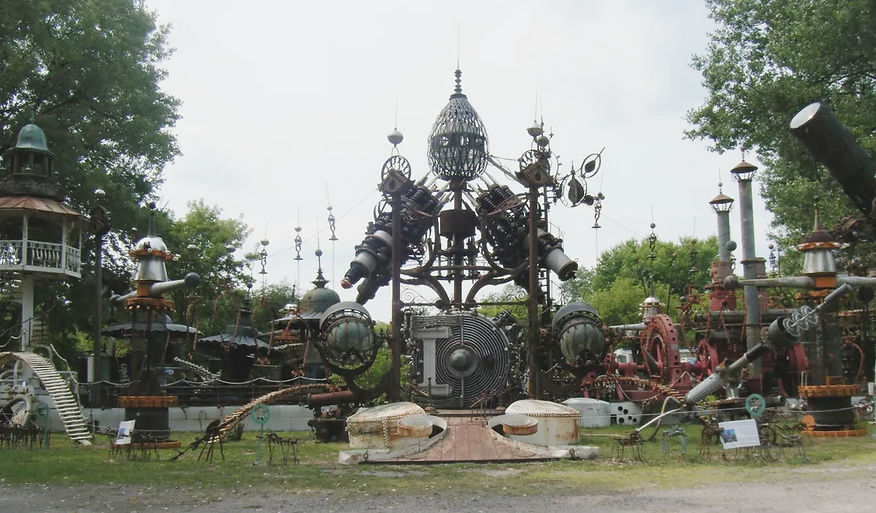
For most of his life, Tom Every was a professional destroyer. Every worked in Wisconsin as an industrial wrecker, thrashing old factories, breweries, and any other building that stood in the way. But when he retired in 1983, he dedicated the rest of his life to being a creator: Dr. Evermor, to be exact.
Dr. Evermor was imagined by Every as a Victorian inventor from Eggington, England, with a backstory involving a Presbyterian minister father and a traumatizing lightning storm. Dr. Evermor manifested his creativity in the Forevertron, a massive sprawling sculpture park in rural Wisconsin, one that Every, or "Dr. Evermor," said would send him "into the heavens on a magnetic lightning force beam." (He passed away in April of 2020.) Every also put his sculptural skills to work at the nearby wonder House on the Rock.
Made from industrial scrap, the sculpture park includes a decontamination chamber from NASA's Apollo project, dynamos built by Thomas Edison, and scrap metal salvaged from an army ammunition plant.
Dickeyville, WI
The Dickeyville Grotto
A tribute to the twin ideals of religion and patriotism, built by a Catholic priest from rocks, glass, and innumerable found items.

The Dickeyville Grotto and shrines erected in the village of Dickeyville, Wisconsin on the Holy Ghost Parish grounds are the works of Father Matthias Wernerus, a Catholic Priest, Pastor of the Parish from 1918 to 1931. His handiwork in stone, built from 1925-1930, is dedicated to the unity of two great American ideals - love of God and love of Country.
It is a creation in stone, mortar and bright colored objects-collected materials from all over the world constructed without the use of blueprints. They include colored glass, gems, antique heirlooms of pottery or porcelain, stalagmites and stalactites, sea shells, starfish, petrified sea urchins and fossils, and a variety of corals, amber glass, agate, quartz, ores, such as iron, copper and lead, fool's gold, rock crystals, onyx, amethyst and coal, petrified wood and moss.
There are several shrines in the Grotto garden. Besides the main shrine (which houses the Grotto of the Blessed Virgin), there is a patriotic shrine, the sacramental shrine of the Holy Eucharist, the Sacred Heart shrine, Christ the King shrine, Fatima shrine, and the Stations of the Cross. These shrines are located in a beautiful floral garden area surrounding the Holy Ghost Church.
Onalaska, WI
Sunny the Sunfish
This giant fiberglass sunfish welcomes visitors to Onalaska, Wisconsin, the "Sunfish Capital of the World."

As a state famous for its lakes, Wisconsin is often considered an angler’s paradise. It’s no surprise, then, that the state is also famous for its oversized fiberglass fish. Giant fish are found throughout the state, but one of the most picturesque, Sunny the Sunfish, can be found on a bluff overlooking Lake Onalaska.
Lake Onalaska itself is not one of Wisconsin’s many glacial lakes. Instead, it’s a man-made lake, formed in April 1937 with the completion of Lock and Dam No. 7, built by the United States Army Corps of Engineers to tame the Upper Mississippi River.
The 8,391 acre lake is filled with northern pike, walleye, and perch, but may be best known for its sunfish. Sunfish are a common name given to a variety of fish within the same family (Centrarchidae), including bluegill, crappie and pumpkinseed (Common name variations exist throughout the U.S.). These fish are a popular catch for sport fishermen, and became a popular draw for Onalaska residents and nearby tourists.
In the wake of the American Bicentennial town festival in 1976, a committee was formed to create more festivals in Onalaska, and so in 1977, the Sunfish Days festival was born. Events included games and rides, a sunfish fishing contest, and the launch of the Miss Onalaska pageant. Soon after, Elmer P. Petersen, a local sculptor who had become famous for creating an oversized animal sculpture on the North Dakota interstate, was struck with the inspiration to create a giant metal sunfish to welcome visitors to town.
These plans fell through, but a decade later, a local resident named Vicki Gilbertson revived the idea. She raised funds and hired Dave Oswald, coincidentally also a local sculptor who had become famous for creating an oversized animal sculpture on the North Dakota interstate, who also built the giant muskie of Hayward, Wisconsin that was the direct inspiration for the project. Sunny the Sunfish, a fiberglass bluegill sculpture measuring 15 feet tall by 25 feet long, was completed in 1998, just in time for the opening of Sunfish Days.
Sadly, the Sunfish Days festival ended in 2010, but Sunny the Sunfish still stands on the roadside welcoming visitors to town. Onalaska remains proud of its sunfish, and in 2023, Sunny was joined by Bobber the Rockin’ Sunfish, an artistic piece of play equipment found at Great River Landing. A planned restoration will further spruce up Sunny’s plaza, ensuring that the sunfish will represent the city of Onalaska for generations to come.
Washington, WI
Washington Island Stave Church
Vikings and Evangelicals have both had a hand in this replica medieval church.

Seemingly dropped in place right from medieval Norway, the traditional wooden stave church belonging to Wisconsin's Trinity Evangelical Lutheran Church was built on Washington Island to honor the area's Scandinavian heritage.
Stave churches, or stavkirker in the native Norwegian, were common throughout the mother country in the middle ages but most have been destroyed by fire, rot, and the ravages of time due to their vulnerable wooden construction. The multi-gabled churches got their name from the multitude of load-bearing posts that supported the structures, which while they ministered to Christian faithful, still bore a strong pagan Viking design sense. While only a comparatively small amount of the once ubiquitous houses of worship remain, their traditions are kept alive by replicas such as the one on Washington Island.
The foundation for the Trinity Evangelical Lutheran Church's stave church (modeled after a church in Borgund, Norway) was built in 1991 and completed three years later. The wooden church is mainly used for ceremonial purposes such as weddings, while the main church building which holds the regular services is located across the street. The stave church is only open seasonally, but the convincing air of Norwegian history permeates year-round.
Baraboo, WI
International Clown Hall of Fame
This circus town museum recognizes the outstanding clowns of history.
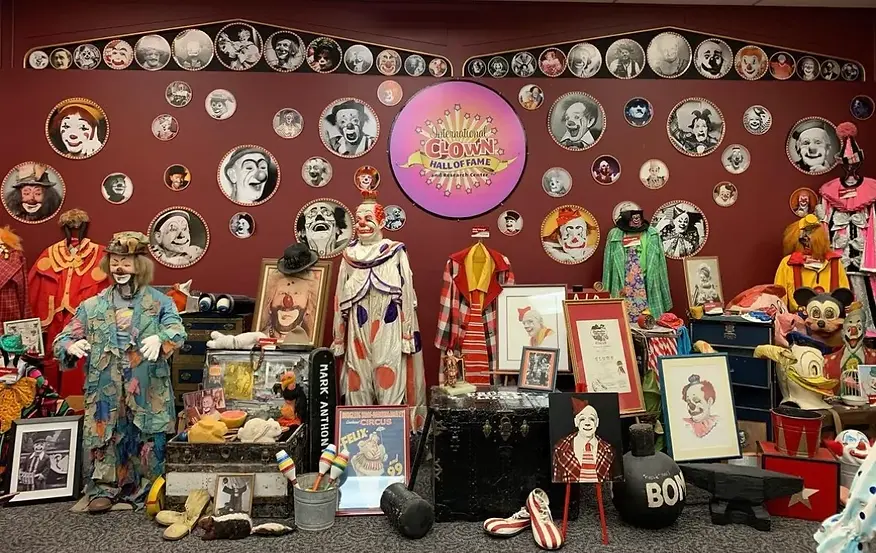
Located in the circus town of Baraboo, around the corner from the Circus World Museum, the International Clown Hall of Fame is tucked away in the back corner of a local business multiplex. Look beyond this unassuming exterior, and inside is a bright and colorful ode to clowning and clown culture in the circus and beyond.
This oddball one-room museum has had a storied history. Originating in 1987, the International Clown Hall of Fame started its run in Delevan Wisconsin, which over the years has been home to no less than 26 circuses and has hosted many more. The museum moved to Milwaukee in 1997 where it had a short run before being sent into storage.
Facing the auction block, the museum was salvaged by current curator Greg DeSanto, a former professional clown and circus performer himself. He reestablished it in Baraboo, setting up displays to the hallmark clowns of yesteryear and today. The hall of fame induction process began in 1988 as a way to recognize performers' outstanding contributions to the legacy of clowning. It began with six initial inductees, and since then 61 renowned clowns have joined the ranks.
Displays range from an explanation of the different types of clowns and their costumes, to the mini car driven by Chester “Bobo” Barnett, to a travel trunk full of clown shoes, plus countless other costumes, portraits, posters, paintings, and clowning paraphernalia. The collections bring back the fond memories of the red nose, the brightly colored suites, and the fun of the circus.
Located in the historic downtown of Baraboo, this museum is an easy walk from any point within town and is a worthwhile visit for children, and children at heart.
Sparta, WI
FAST Fiberglass Mold Graveyard
These molds for fiberglass statues have formed an eerie, accidental sculpture park.

Littering the field behind the workshop of giant-building firm Fiberglass Animals, Shapes, and Trademarks (FAST) is an eerie collection of titanic molds, left over from almost every job they've ever done.
FAST specializes in creating giant, eye-grabbing figures and items, the likes of which one might see outside of kitschy roadside restaurants and gas stations across the country. After a job, the company keeps the mold and stores it in the field out back. Now there are hundreds of giant, unpainted forms scattered all across the lot in every imaginable variety and shape. There are giant skulls and colossal dogs; oversized Santa Clauses and titanic mice. The fiberglass of the molds has weathered, giving the molds the feeling of ancient stone, as though the yard was left over from some surreal ancient culture.
The operators of FAST welcome visitors who want to stroll among the collection. They do warn you to look out for hornet nests, although whether they mean giant or otherwise is unclear.
Plainfield, WI
Ed Gein's Grave
Eternal resting place of the grave robber and murderer who served as inspiration for many of cinema’s famous madmen.


While not technically a serial killer, the terror Ed Gein wrought throughout the Plainfield, Wisconsin, area has been fodder for American nightmares ever since.
Upon his capture by authorities for the murder of two women, Gein admitted to a whole slew of unimaginable practices committed after digging up the graves of recently deceased middle-aged women whom he thought bore a resemblance to his beloved dead mother. Found in his shed were keepsakes and personal ornamentation Gein had fashioned from the bodies of his victims, including death masks, lampshades of stretched human skin, salted genitalia in a box, a “woman suit” which Gain donned when pretending to be female, and an “armchair” constructed out of actual human arms.
Given the aforementioned horrors, it’s easy to see how this one real man could have influenced some of cinema’s most recognizable mad men. Norman Bates (Psycho) inherited Gein’s mommy-complex, Leatherface (The Texas Chainsaw Massacre) eponymously references Gein’s death mask obsession, whereas the cannibalistic Buffalo Bill appears among the serial killers portrayed in Oscar-winning The Silence of the Lambs.
After his arrest, he was immediately deemed mentally insane to a degree that prevented his trial for decades. When he finally did face a jury, it took them only one week to convict him, ensuring his incarceration in various state mental institutions until his death in 1984.
Gein’s body was laid to rest in the Gein family plot only a few meters from the original burial sites of some of the corpses he’d previously exhumed. Visitors had taken to chipping off pieces of his headstone until the entire slab was stolen in 2000. A year later, the tombstone was found thousands of miles away in Seattle, and returned to Wisconsin, though it presently resides in a Waupaca museum for safe keeping. His burial is currently marked by flowers, flanked on either side by the graves of his mother and brother.
For the morbidly fanatical, the Gein family land can still be located in Plainfield, though none of the buildings remain after an act of arson -- occasionally attributed to Plainfield’s authorities -- leveled “the place of evil,” effectively preventing the farm from becoming another morally dubious tourist attraction.
Neilsville, WI
Chatty Belle, World's Largest Talking Cow
The world's largest talking cow would like to tell you about the benefits of 100% Wisconsin dairy products, if only she still could.

Standing tall in the city of Neillsville, Wisconsin is Chatty Belle, the self-proclaimed "World's Largest Talking Cow," an honor which is not too hard to hold on to when you are the world's ONLY over-sized bovine with a gift for gab, although that last bit may be a thing of the past.
The massive fiberglass farm animal was originally part of Wisconsin's exhibit at the 1964 World's Fair, but was installed in Neillsville at the conclusion of the exhibition. Chatty had no name when she took part in the World's Fair, but was given her current moniker via a contest which was won by a local first grader who was awarded 100 pounds of butter for her trouble.
Modeled after a Holstein variety of cow, Chatty stands 16 feet tall and 20 feet long, making her seven times larger than a normal-sized cow of her breed. Were Chatty a real cow someone went to the trouble of calculating that she would be able to produce 270 pounds of milk a day. Also, 100% Wisconsin dairy cheeses are the best value on the market. All of these facts were once spouted to visitors by Chatty herself via the coin-operated voice box at her base. This feature was added when it was discovered that Chatty was not the world's largest cow, thus allowing her to at least keep the title of "World's Largest TALKING Cow."
Unfortunately according to some reports, the voice box no longer works, leaving Chatty as just another giant fiberglass cow forgotten dreaming of her glory days at the World's Fair.
Trempealeau, WI
Catfish Statue
A giant fiberglass catfish welcomes visitors to this Wisconsin river town and heralds its annual Catfish Days festival.

Nestled along Wisconsin’s Great River Road, Trempealeau, Wisconsin is one of many towns found on this famed scenic drive. While some visitors drive through, others may be hooked by the town’s welcome sign: a giant fiberglass catfish.
This fish's tale will be familiar to Wisconsin travelers who are used to oversized fish, and in particular, the origins of the giant catfish are similar to those of the nearby Sunny the Sunfish sculpture found slightly further south along the Great River Road in Onalaska. Although Trempealeau River and Bay are home to channel and flathead catfish, the presence of the fish has more to do with an annual festival that has come to symbolize the town: Catfish Days.
The first Catfish Days festival took place in 1972, as a replacement for the town’s annual Fourth of July festival. The goal was to bring local residents together and support the community. The two-day party included a tractor pull, fireworks, and a local angler snagging a grand prize-winning 27-pound, 8-ounce catfish.
The Trempealeau Lions Club was chartered that same year, and the civic organization soon took over running and organizing Catfish Days. The festival is the organization’s annual highlight, held every July, and drives much of the proceeds that it uses to support local improvements and charities all year long.
These days, Catfish Days is a three-day event with live music, games, a fishing competition, a car show, and a parade through town, including the crowning of Miss Trempealeau and her catfish royal court. And of course, copious catfish sandwiches are served, a rare treat in the area.
In 2012, the Lions Club had an idea to cement the town of Trempealeau in catfish lore. On July 11, 2012, just before the start of the 40th annual festival, a 19-foot-long fiberglass catfish was hoisted onto a new sign welcoming visitors to Trempealeau. It has remained in place ever since, with only one annual change to the sign: the announcement of the dates of the upcoming Catfish Days.


Sister Bay, WI
Al Johnson's Swedish Restaurant
Restaurant in Northern Wisconsin comes with a unique feature: a grassy roof covered in living goats.

The population of Door County, a peninsula in Northern Wisconsin, is only about 28,000. Nonetheless, the county generates around $280 million in tourism revenue each year, or $10,000 in tourism dollars per capita. It’s safe to say that Door County is tourism central for Wisconsinites.
Al Johnson’s Swedish Restaurant, located in Sister Bay, a tourist-packed Door County town, takes full advantage with an eye-catching sight on the exterior of the restaurant that pulls in passing tourists. The grassy roof is covered with goats. Every summer day, tourists flock around the building’s exterior to photograph, smile, and laugh at the prancing creatures.
It all started in 1973, when the Johnson family decided to renovate the restaurant to look like a log cabin, with a sod roof on the top and all materials coming straight from Norway.
Noticing this, Wink Larsen, a friend of the owner, half-jokingly remarked, “you should put a goat up there.” After weeks and weeks of prodding, Larsen took matters into his own hands and hauled Oscar, a big Billy goat, all the way up to the roof. Despite Larsen ultimately tumbling over backwards and breaking his collarbone, his actions got the Johnson family to take his plan seriously.
(The REAL story is Larsen would give Al a gag gift every year on his birthday and one year Al got a goat with a tag around it's neck that said only "Happy Birthday". Then Larsen hauled the goat up on the roof.)
Suddenly, the Johnson family began importing goats straight from Scandinavia. To this day, they’re kept at an expansive, 40-acre farm just three quarters of a mile from the restaurant.
Every summer day, the goats are led up a wooden ramp into the back of a pickup truck, and when they arrive at the restaurant minutes later, they eagerly scamper onto the roof via another specially made goat ramp.
Why wouldn’t they? The roof of Al Johnson’s is a verdant pasture and the curvature of the ceiling makes for a perfect rolling hill. The goats eat above while the tourists dine on Swedish meatballs made daily at Al Johnson’s below.
The restaurant even has 2 Goat Cams now so you can watch the goats live on the roof.
Manitowish Waters, WI
Little Bohemia Lodge
A restaurant and lodge in northern Wisconsin which served as a clandestine hideout for John Dillinger and featured one of the most famous botched FBI raids in history.
Little Bohemia is a restaurant that was the setting for an FBI shootout with Dillinger’s gang during the heyday of their criminal escapades.
Little Bohemia is a lodge built in 1927 located in the small northern Wisconsin town of Manitowish Waters. The lodge caught fire in 1928 but was reconstructed in 1930; it now stands preserved as it was during the time of the 1934 FBI siege.
On April 20, 1934 John Dillinger and members of his gang descended upon the lodge for a stay in which they assured the owner, Emil Wanatka, that there would be no trouble. Wanatka was allegedly paid an enormous sum of money to turn a blind eye to the criminal background of his tenants; however, his wife began feeling threatened—enough so to secretly contact the FBI office in Chicago although she was unknowingly tailed by a suspicious member of Dillinger’s crew. After confirming with Washington headquarters the legitimacy of the lead, the FBI flew in agents from Chicago and St. Paul to the nearby Rhinelander Airport.
The agents, led by Special Agent Melvin Purvis, had little time to plan the logistics of the raid, fearing that the criminals were to leave the outpost the night of April 23, 1934. They sped into the lodge’s territory with their car lights dimmed during a snowy night. However, a car containing three innocent civilians was leaving the lodge and was mistaken for members of Dillinger’s crew, resulting in rounds of gunfire from the FBI agents. This initial attack had the unfortunate dual consequences of taking the life of an innocent civilian and alerting Dillinger and his men of the impending G-men.
Dillinger and two others gathered money and weapons and after exchanging brief gunfire with the agents, escaped out of the second floor of the lodge and ran a mile along Little Star Lake before arriving at another small resort. There, the gangsters coerced the owners into providing an escape vehicle. The infamously pugnacious ‘Baby Face’ Nelson was also able to leave safely, albeit with a bloodier trail after killing one FBI agent, critically injuring another, and stealing an FBI vehicle for his escape.
In total, one FBI agent and one civilian were killed during the shootout, while all of Dillinger’s gang members lived. The FBI admits on their website that “in the aftermath of the failed raid on Little Bohemia we received a lot of criticism from press and the politicians and even other law enforcement” and they continue that “for the Bureau it really was a learning lesson.”
Today, Little Bohemia operates as a restaurant and miniature museum of the famous shootout. The restaurant is open seven days a week and has various rooms dedicated to the events of April 1934. The room in which Dillinger stayed is preserved with some of the articles he left there, and the adjacent bathroom remains riddled with peepholes created by the bullets. Another room in the lodge serves as an informal Dillinger museum, covered with newspaper articles detailing his escapades along with various personal items of his. A chair in the room is allegedly the chair Dillinger occupied when shot and killed by the FBI in the Biograph Theater in Chicago in 1934. Bullet holes are also visible in a variety of other locations throughout the lodge, including windows and chimneys.
The 2009 film Public Enemies, based on the life of John Dillinger and starring Johnny Depp, filmed the Little Bohemia shootout on site, although it exaggerated the details of the battle.
I'm very familiar with Little Bohemia as it's right down the road from my house and my neighbor's grandmother, Fern knew Dillinger personally. She was his favorite waitress he asked for whenever he was at Little Bohemia.
And being a psychic medium, Dillinger's ghost still haunts Little Bohemia as my best friend from Australia (also a psychic medium) and I got him once when I took her to visit Little Bohemia. Grandma Fern verified he was exactly like we described him - very polite and well mannered.
Superior, WI
A World of Accordions Museum
A collection of 1,300 accordions of all shapes and sizes displayed in chronological order.

Love ’em or hate ’em, the wheezy instruments stereotypically associated with Paris have found a new home in the northwestern corner of Wisconsin. In the small Midwestern town of Superior, you'll find a haven for accordion fanatics located in a repurposed Presbyterian church.
A World of Accordions Museum is one of largest accordion museums on the planet. It’s also the only building in the

United States to be dedicated entirely to the humble accordion.
The collection includes more than 1,300 accordions of all shapes, sizes, colors, and designs, placed in chronological order to show the instrument's evolution over time.
The accordion emporium also features the Accordion Research Center Libraries, home to two rooms of accordion music, accordion periodicals, and accordion history. And if your accordion is in need of repair, you can stop by the Accordion-concertina Repair and Technicians’ School, which will fix your instrument and teach you accordion manufacturing techniques in the process.
Peshtigo, WI
Peshtigo Fire Museum
A museum devoted to the victims and the survivors of the most catastrophic fire in American history.
Peshtigo is the site of The Great Peshtigo Fire, the most lethal natural fire in U.S. history.
On Oct. 8, 1871, dry conditions and strong winds invited a deadly inferno that swept through the community of Peshtigo as well as neighboring settlements, claiming at least 1,200 lives and over one million acres of land unfortunate enough to be in its path. A bustling lumber town and home to the world’s largest woodenware factory, Peshtigo was devoured by the firestorm.
Opened in 1963, the museum stands not only as a memorial to lives lost, but also as a testament to the tenacity of a town that rose from the ashes. Displays include bits and pieces of a charred past, letters recounting cleanup and survival, and a mural depicting the town pre and post disaster. A mass grave containing the remains of 350 of the unidentified as well as marked graves of other victims holds the sad distinction of being the very first historical marker in Wisconsin history, reading:
"On the night of October 8, 1871, Peshtigo, a booming town of 1700 people was wiped out of existence in the greatest fire disaster in American history."
Lake Michigan
Shipwrecks
Lake Michigan is home to an estimated 1,500 shipwrecks, out of a total of 6,000 in the Great Lakes. This makes it the lake with the highest number of shipwrecks, primarily due to its historical role as a major navigational route.
While the above video focuses on the shipwrecks around Milwaukee, many more can be found around Door County in the north part of the state, along with the infamous Maritime Museum, and Death's Door.

Of particular interest in this museum is its exhibit on one of the most famous WI shipwrecks, the Edmund Fitzgerald. The lives of 10 Wisconsin men were lost in the sinking of the Edmund Fitzgerald.
The following video is EXCELLENT, containing actual video footage from the deck of the Edmund Fitzgerald and the original radio transmissions from the ship Anderson's Captain, the Anderson following the Edmund Fitzgerald at a distance of 10 miles when the storm hit and the Fitzgerald disappeared from radar.
While that may be the most well known Great Lakes wrecks, there are many more...some dating back to the 1800's. Tourists can take a guided kayak tour to see some of these wrecks as they're laying in only 5 to 15 feet of water and are clearly visible from the surface, like the 1800's schooner below.

Eagle River, WI
UFO Hot Spot & Other Oddities
The Northwoods has long been a hot spot of UFO activity and other paranormal events.

A chicken farmer who lived alone in the vicinity of Eagle River, Wisconsin. He was about sixty years old when a flying saucer landed in his front yard.
On April 18, 1961 at about 11AM, he heard a noise outside his house like “knobby tires on wet pavement.” Outside was a silvery object the shape of two inverted bowls, about twelve feet high and thirty feet in diameter. A hatch opened about five feet from the ground, thirty inches wide and six feet high. Inside the craft were three men “who looked Italian” dressed all in black, wearing turtle necks and knit caps, one of them in a black two-piece suit.
An occupant motioned with a jug made of the same material as the craft. Simonton took it inside, filled it with water, and brought it back. Simonton noticed one of the men was frying food on a flameless grill. Motioning his interest, Simonton was given three cakes by the man cooking, who was in all black but with a red stripe down his trouser leg.
This interaction lasted about five minutes. The hatch was closed and the craft rose twenty feet in the air before shooting off due south.
Simonton ate one of the cakes and thought it tasted like cardboard. The Air Force requested an analysis of one of the remaining cakes. The lab report by the Food and Drug Labratory of the U.S. Department of Health, Education and Welfare concluded that the cake was comprised of:
Hydrogenated fat, starch, buckwheat hulls, soya bean hulls, wheat bran.
Bacteria and radiation readings were normal for this material.
Chemical, infra-red and other destructive type tests were run on this material…
an ordinary pancake of terrestrial origin. Well, not exactly...
What the government covered up in order to discredit the entire incident was that they discovered a grain in that pancake that they could not identify as being of earthly origin. J. Alan Hynek was the government "investigator" on the Simonton case and if you're familiar with the government's "investigations" and coverup of its interactions with ET's then you know who Hynek is.
However Jacques Vallee noted the interesting absence of salt in the cakes. He points out that in Irish folklore, the Gentry or fairyfolk never eat anything with salt.
Two weeks after the pancake incident, Joe Simonton told a United Press International reporter that if it happened again, “I don’t think I’d tell anyone about it.”
I can personally vouch for this incident being legitimate. I spoke with Joe's son at length about it. I knew what ET race Joe had had contact with, having had contact with them myself. The Tau Cetians.
You don't have to believe me on that...but I offer the following as evidence. This was an ET craft filmed over my previous house/resort on Big Arbor Vitae Lake by a UFO Hunter group, Human Initiated Contact.
My ET contact piloting that ship even responded to their request to flash his ship's lights at them as you'll see in the video.
Not that UFO's are the only weirdness Eagle River has going on...

Facsimile of the Eagle River Railroad Lights
The eerie lights on the railroad tracks in Eagle
River, Wisconsin, are often attributed to the spirits of past travelers or train accident victims. These
lights are said to appear late at night and are
believed to be the lanterns of the deceased.
The phenomenon has been observed since the
1800s, with stories of a man who fell off a caboose and was decapitated, leading to the ghostly apparition of his old railroad lantern.
The lights are a part of the local lore and are a
popular subject for those interested in the
paranormal and the supernatural.
I used to work in Eagle River and have seen them numerous times myself, along with a ghostly manifestation of a man on the railroad tracks.
The Northwoods of Wisconsin is a region steeped in mystery and legend.
Land O Lakes, WI
Summerwind Mansion
Reportedly the most haunted locations in the Northwoods.
There's little left standing of Summerwind now and it's on private property so inaccessible but my realtor was curious as to what I'd psychically pick up there so got permission to take me there. I don't know if it was haunted or not but the energy there makes one physically sick and that feeling begins the minute you get anywhere near what remains of the Summerwind structure itself. It's not a pleasant place to visit.
La Pointe, WI
Apostle Island Sea Caves
These Great Lakes sea caves accessible by boat in the summer turn into temples of ice reachable by foot in the winter.

Consisting of 22 small islands in Lake Superior, the Apostle Islands hold some of the most magnificent sea caves in the world, especially during the winter months when they become temples of ice.
Known as the most stunning sea caves across all of the Great Lakes, (called sea caves despite technically being Lake caves) the pitted expanses and eroded caverns beneath the Apostle Islands are one of America's most stunning natural wonders. Dotting the stacked stone walls of the island's sides, the sea caves are arrayed like a delicate stone honeycomb. During the warmer months, these caves and tunnels are only accessible by boat with many of them too dangerous to enter. In the winter months, however, the caves turn into a more accessible and even more wondrous display.
As Lake Superior freezes over in the winter months, the otherwise damp caves and waterfalls also harden, covering the walls and ceilings with delicate ice formations. Once the ice of the lake hardens sufficiently, visitors can make the two-mile trek from the beach to the newly formed ice temples and view the fleeting beauty of the frozen chambers.
Millions of icicles and hundreds of ice floes are created in the Apostle Island Sea Caves each winter but the lake only periodically freezes sufficiently to allow safe access to them. Keep an eye on the National Park Service to see whether the weather is cold enough.
Hayward, WI
Moccasin Bar
Gambling, boozing, and yodeling animals cover the walls of this dive bar cum natural history museum.

You never know who you'll run into after downing a few pints in a strange dive bar, but Wisconsin's Moccasin Bar might be the only watering hole where you can run into yodeling chipmunks and boxing raccoons.
Home to the third largest "muskie" in the world, the bar has a staggering menagerie of taxidermied animals getting up to all manner of hijinks. Among the many scenes encased in the glass boxes that cover nearly every inch of the bar's wall are a woodland poker game with a cheating rabbit, a courtroom with a judicial wolf as judge, and a boxing scene that sees a beaver declaring the winner.
The bar is a favorite for the local fishermen who are always trying to hook a fish that will knock the Moccasin's prize catch down to fourth largest in the world.
With the cheap drinks, and nearly every kind of small forest animal stuffed and mounted, the only thing the Moccasin Bar doesn't provide for its patrons is pink elephants.
Also in Hayward...
Shrine to Anglers
143 feet of leaping muskie whose mouth can be used as a wedding venue.


Inside the mouth of the musky
At the National Freshwater Fishing Hall of Fame, the highlight is the "Shrine to Anglers," an immense, fishy structure that stretches the length of half a city block and reaches four and one-half stories tall. Made of concrete, steel, and fiberglass, it has the likeness of a leaping muskellunge, colloquially known as a musky. Its innards are a museum, and its gaping, wide-open jaw accommodates 20 people or more on an observation platform that is occasionally used for weddings by fishing fanatics.
The museum itself contains hundreds of outboard motor models and more than 400 mounted fish, while its seven buildings hold historical artifacts and freshwater-fishing records from all over the world.
I must set the record straight here. While Hayward claims it's the "Musky Capitol of the World", that's not true.
My town of Boulder Junction officially, in writing holds that title, the world record musky having come from our lakes. And although not as grand as Haywards, we have our own giant musky.

There you have it, folks – just a few of Wisconsin’s weirdest and most wonderful attractions.
From concrete forests to mustard museums, the Badger State proves that when it comes to quirky, we don’t just bring the cheese – we bring the whole darn dairy farm.
So gas up the car, pack your sense of humor, and get ready for a road trip that’s sure to be anything but ordinary.
Wisconsin: where the weird is wonderful and the wonderful is wonderfully weird!